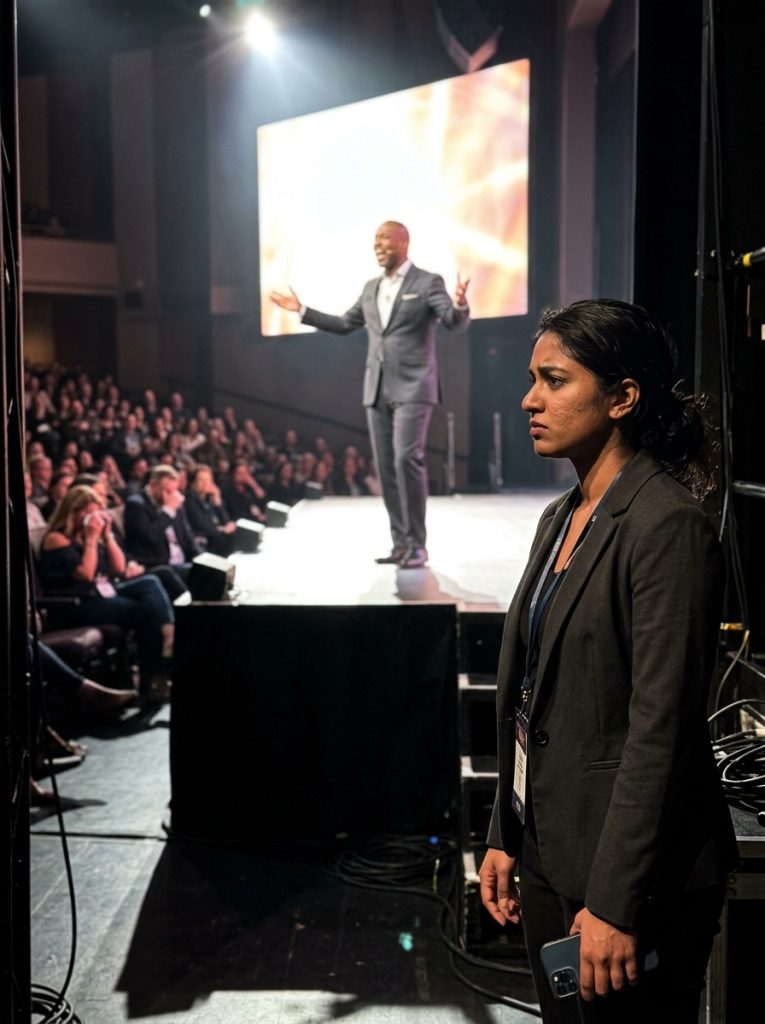
I didn’t post anything that night. I want to be clear about that, because the impulsive version of this story is satisfying and also a good way to ruin your life and be wrong.
I stood in the wings, and I shook a little, and I put my phone back in my pocket. Then I went home and I did the boring, careful thing.
First, I made sure I was right. The onboarding documents I’d seen internally were one thing, but I wasn’t going to build my entire future on a stack of private HR files I’d happened to process. So I went looking for what was already public and verifiable. It turned out a lot of it was. Preston’s company had taken outside investment years ago, and the disclosures from that — filings, an old press release the company had quietly buried, an early interview from before he’d polished the myth — laid out the family backing in plain language. There was even a profile from fifteen years earlier, when nobody was paying attention, in which a younger Preston cheerfully credited “my family’s support” for getting him off the ground. He’d given the true version himself, once, before he discovered the false one sold better.
So the truth wasn’t a leak. It was a matter of record. He’d simply bet that no one would line up the public documents against the stage myth.
Second, I thought hard about why I was doing it. Not for revenge — Preston had never wronged me personally. I kept coming back to the faces in those seats. The young founders crying. The kid clutching the notebook. People walking out of that arena believing that the only difference between them and Preston was hunger, when the real difference was a six-figure platform built under his feet before he started. That myth doesn’t just flatter him. It hurts them. It tells a generation of strivers that the reason they’re struggling is that they don’t want it badly enough.
That’s the lie I couldn’t let stand.
Third, I did it the right way. I wrote it up carefully, soberly, no insults, no leaked private data — just the public, verifiable record laid next to the quotes from his keynote, side by side. “Here’s what he said on stage. Here’s what the filings, his own earlier interviews, and the public record show.” I let the contrast do the work. I attached the sources. I put my name on it, because I wasn’t going to throw a stone from behind a wall.
I gave myself one rule before I wrote a single word: every fact had to be public and verifiable, or I wouldn’t use it. Not because I was scared — though I was — but because the moment I included one piece of private paperwork, the story would become “vindictive intern leaks files” instead of “the man’s own record contradicts his myth.” The truth only works if it can survive being checked.
So I checked. I lined up the investor disclosures, the buried old press release, the fifteen-year-old profile where a younger Preston had cheerfully thanked his family for the head start. I screenshotted his keynote quotes word for word. I built the whole thing as two columns: here’s what he said on stage, here’s what the public record shows. No insults. No name-calling. Just the gap, laid bare, with every source linked.
Then I sat with it for a night, because a thing you can’t take back deserves at least one night of sleep.
Then I posted it. And I braced.
It went everywhere. Faster than I imagined. Because thousands of the people who’d been in that arena, and many more who’d bought the books and followed the podcast, had built a little piece of their own hope on Preston’s story — and when someone laid the receipts next to the myth, they felt the floor move.
The first day was euphoric and then terrifying. The post took off. Then came the backlash — not at Preston, at me. His defenders came hard. I was a “disgruntled intern.” A “nobody.” I was “jealous.” I was “leaking confidential information” (I wasn’t — every source was public, and I’d been careful precisely so that accusation couldn’t stick). For about forty-eight hours I was sure I’d ended my career before it started.
Then the tide turned, because facts are stubborn and I’d sourced every single one. Journalists pulled the same public filings and confirmed them. The fifteen-year-old interview where Preston credited his family resurfaced on its own. His team’s denials got weaker as the documents got harder to wave away. The story stopped being “intern attacks CEO” and became “CEO’s signature origin story doesn’t match the public record.”
Preston’s brand was the myth. Once the myth cracked, a lot of it cracked with it. The book deal for the sequel quietly evaporated. Speaking invitations dried up. The board, which loves a guru right up until the guru becomes a liability, began to “explore a transition.” He didn’t go to prison — he hadn’t committed a crime. He just lost the thing he’d actually built his fortune on the second time around: people’s belief that he was one of them.
The company, in the fallout, did something I didn’t expect. After the dust settled, the new leadership reached out to me — not to fire me, which I’d assumed, but because the whole episode had become a case study in why telling strivers a false story about fairness is corrosive. They asked me to help build something real: a transparency initiative, and an actual paid fellowship for young people from backgrounds that don’t come with a platform. Not a myth about bootstraps. A real ladder.
I almost said no. I was tired, and I’d learned the hard way what it costs to be the person who says the true thing out loud. But then I thought about the kid with the notebook, and I said yes.
Saying yes to that fellowship was the one condition I had for staying with the company at all. I almost walked away from the whole industry after the storm I’d weathered. I’m glad I didn’t.
I run that fellowship now. We bring in young people who started with nothing — actually nothing, the real thing, not the stage version — and we give them what Preston pretended he didn’t have: capital, connections, a platform. The thing I tell them on the first day is the opposite of the keynote.
I tell them the game is not always fair. I tell them some people climb ladders with platforms built underneath, and that it’s not their fault if they’re climbing without one. And then I tell them we’re going to build them a platform anyway, out loud, with no myth attached, because the truth is a better foundation than a beautiful lie.
People ask if I feel bad about what happened to Preston. Honestly, not really. He wasn’t punished for coming from money — there’s no shame in that, and I’d never have posted a word if he’d just told the truth. He was undone by the lie he told ten thousand hopeful people to sell them a feeling. He had the real story once. He told it himself, fifteen years ago. He could have kept telling it. It was a good story: a man given a head start who did something with it. That’s worth respecting.
Instead he stood on a stage and told a generation of strivers that their struggle was a character flaw.
I just stood in the wings and held up the receipts.
The boring, careful, verifiable receipts. They turned out to be louder than the brightest stage in Nashville.