The Letter Carmen Left Behind Changed Everything Diego Believed About Her
PART 3 (FULL STORY)
I turned the page slowly, afraid that whatever came next would somehow make the last few months feel different.
The handwriting was shaky, but Carmen had written every word herself.
“Diego, I know you think I failed to pay you. I know you probably think I used your kindness because I kept promising that I would give you the money later. I am sorry for letting you believe that.”
I stopped reading.
Across from me, her daughter remained silent.
I looked back at the letter.
“I had the money for some of the things you bought for me. I did not have enough for everything. But that is not why I kept asking you to wait.”
My fingers tightened around the paper.
“I wanted to know whether you would keep coming if there was nothing in it for you.”
I swallowed hard.
The words should have made me angry.
Instead, they hurt in a way I wasn’t prepared for.
I continued.
“When you first came to my house, you were a stranger. You cleaned my floors because I promised to pay you. That was fair. You had every right to expect your money.”
“Then you saw my empty refrigerator.”
“You never asked me for anything after that.”
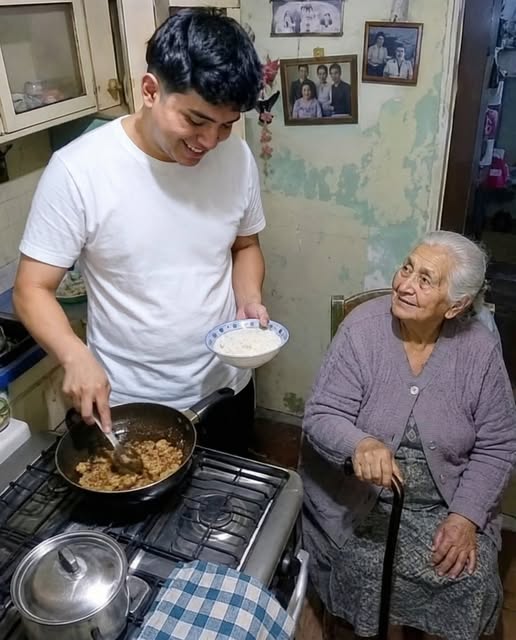
“You simply started bringing food.”
I lowered the letter.
I remembered the first bowl of soup I had made for her.
I remembered how she had held the spoon with both hands because her fingers hurt too badly to grip it properly.
I remembered her smiling after the first bite.
I had thought she was simply grateful for a meal.
Now I wondered how much more she had been trying to tell me without words.
I kept reading.
“My children will tell you that they loved me. I believe they did. But love and presence are not always the same thing.”
“I spent years telling myself that they were busy.”
“I told myself they had families, jobs, responsibilities.”
“I told myself I did not need them.”
“I was lying.”
I looked toward Carmen’s daughter.
She was crying now, quietly.
I didn’t know what to say.
The letter continued.
“After my husband died, this house became very quiet. At first, I thought quiet was peaceful. Then I realized there is a kind of quiet that slowly teaches you that nobody is coming.”
I stared at those words for a long time.
Because I knew exactly what she meant.
Not the same kind of loneliness.
But enough of it.
I had spent most of college worrying about money, rent, food, transportation, exams, and whether I could afford another semester.
I knew what it felt like to count every peso.
But Carmen had been counting something else.
Days.
Visits.
Voices.
People who still remembered to knock.
I turned the page.
Then I found the part that finally explained everything.
“Diego, I did not ask you to wait because I wanted to keep your money.”
“I asked you to wait because I was trying to finish something.”
My eyes moved lower.
“I sold the small piece of land my husband left outside the city.”
I looked up.
Carmen’s daughter nodded.
“She did,” she said.
The letter continued.
“I knew that if I simply gave you the money I owed, you would take it and tell yourself you had done your duty.”
“But you did more than your duty.”
“You brought food when I had none.”
“You took me to the hospital when my children were too far away.”
“You sat beside me for hours.”
“You listened to stories I had told too many times.”
“You never made me feel like an old woman who was taking up space.”
My eyes blurred.
I wiped them with the back of my hand and kept reading.
“I wanted to give you something that would stay after I was gone.”
At the bottom of the page was an address.
Then another sentence.
“Ask my daughter to take you there.”
I looked up immediately.
“What is this?”
Carmen’s daughter took a breath.
“It belonged to my mother.”
“What belonged to her?”
She hesitated.
“The apartment above the old bakery.”
I knew the building.
Almost everyone in that part of Guadalajara knew it.
It was an old three-story property near the market, with faded yellow walls and a bakery on the ground floor.
I had passed it hundreds of times.
“My mother owned the apartment upstairs,” Carmen said. “My father bought it decades ago.”
I stared at her.
“Why didn’t she ever tell me?”
“She didn’t want to.”
That answer sounded strange.
“Why?”
Her daughter looked down at the letter.
“Because she wanted you to keep coming without knowing what was waiting for you.”
We drove there that afternoon.
The whole way, I barely spoke.
I kept thinking about the 200 pesos.
How many times I had worried about them.
How many times I had checked my wallet after leaving Carmen’s house and wondered whether I was being foolish.
When we reached the building, her daughter unlocked a metal door beside the bakery.
We climbed a narrow staircase.
At the top was a small apartment.
It wasn’t luxurious.
But compared with Carmen’s house, it looked almost untouched by hardship.
There was a table.
A sofa.
A bedroom.
A small kitchen.
And on the counter sat another envelope.
My name was on that one too.
I looked at Carmen’s daughter.
She nodded.
“Open it.”
Inside was a property document and a handwritten note.
The document showed that Carmen had transferred ownership of the apartment to me.
I read the page three times before I understood what I was seeing.
“No,” I whispered.
Her daughter didn’t answer.
“This can’t be right.”
“It is.”
“I can’t take this.”
“You already did more for my mother than anyone expected you to.”
I shook my head.
“It’s too much.”
She finally looked directly at me.
“My mother knew you would say that.”
There was another line beneath her words.
I unfolded the note.
“Diego, this is not payment for cleaning my house.”
I stopped.
“It would never be enough to repay the kindness you gave me.”
“This is the chance I wish someone had given my youngest son.”
My breathing changed.
I read the sentence again.
Then I understood why she had said those words outside the hospital.
You remind me so much of my youngest son.
Her daughter sat down.
“My brother died when he was twenty-four.”
I looked at her.
“What happened?”
“He was studying at the university. He wanted to become a teacher. He worked nights to pay for school.”
She looked toward the window.
“He died in an accident on his way home.”
I said nothing.
“He was the reason my mother always watched college students so closely.”
My throat tightened.
“She never told me.”
“She didn’t want you to feel sorry for her.”
That explained the photographs.
The old radio.
The way Carmen had watched me whenever I packed my backpack.
The questions she asked about my classes.
The way she always wanted to know whether I had eaten.
I had thought she was simply lonely.
She was.
But she had also been remembering someone.
I looked down at the apartment papers.
“I still can’t accept this.”
Carmen’s daughter smiled through her tears.
“Then don’t think of it as a gift.”
I looked at her.
“Think of it as my mother finishing something she started a long time ago.”
I went home that evening with the papers in my backpack.
I didn’t sleep.
I kept seeing Carmen sitting in that wooden chair, her cane beside her, waiting for me to finish sweeping.
For months, I had believed I was the one helping her survive.
I realized that she had been quietly helping me survive too.
The next morning, I went back to her house.
It was empty now.
Her furniture was still there, waiting to be sorted.
The broken radio was still on the shelf.
The photographs were still hanging crookedly on the wall.
I walked over to the one of Carmen’s youngest son.
He looked about my age.
For the first time, I understood why she had stared at that photograph whenever I came into the room.
I carefully took it down.
Then I straightened the frame before placing it back.
I didn’t take the apartment and simply walk away from Carmen’s old house.
I sold nothing.
I threw nothing away.
Instead, I finished cleaning the place.
Not because anyone was paying me.
Not because Carmen had left me something.
Because I knew that was the last thing I could do for her.
Weeks later, I moved into the apartment above the bakery.
I used one room as my bedroom and turned the other into a small study.
I kept studying.
I kept working.
And whenever I could afford it, I began buying groceries for elderly people in the neighborhood who lived alone.
I never told them why.
I never asked them to pay me.
Sometimes they tried.
I always refused.
One Sunday morning, I found myself standing outside Carmen’s old house again.
I had brought a small pot of soup.
There was no one there to eat it.
Still, I carried it inside.
I placed it on the old wooden table where she had once sat.
Then I turned on the broken radio.
It crackled for a few seconds before finding a station.
Soft music filled the room.
For months, I had thought I was the young man cleaning an old woman’s house for nothing.
I finally understood that Carmen had never been measuring what I did in pesos.
She had been measuring whether kindness could still exist when nobody was watching.
And somehow, without ever paying me a single peso, she had left me something worth far more than the money I had once been waiting for.
Before I left, I looked once more at the photograph of her son.
Then I straightened it.
Exactly the way I had done it every week for months.
And this time, when I closed the door behind me, the house did not feel empty.
It felt like someone had finally come home.