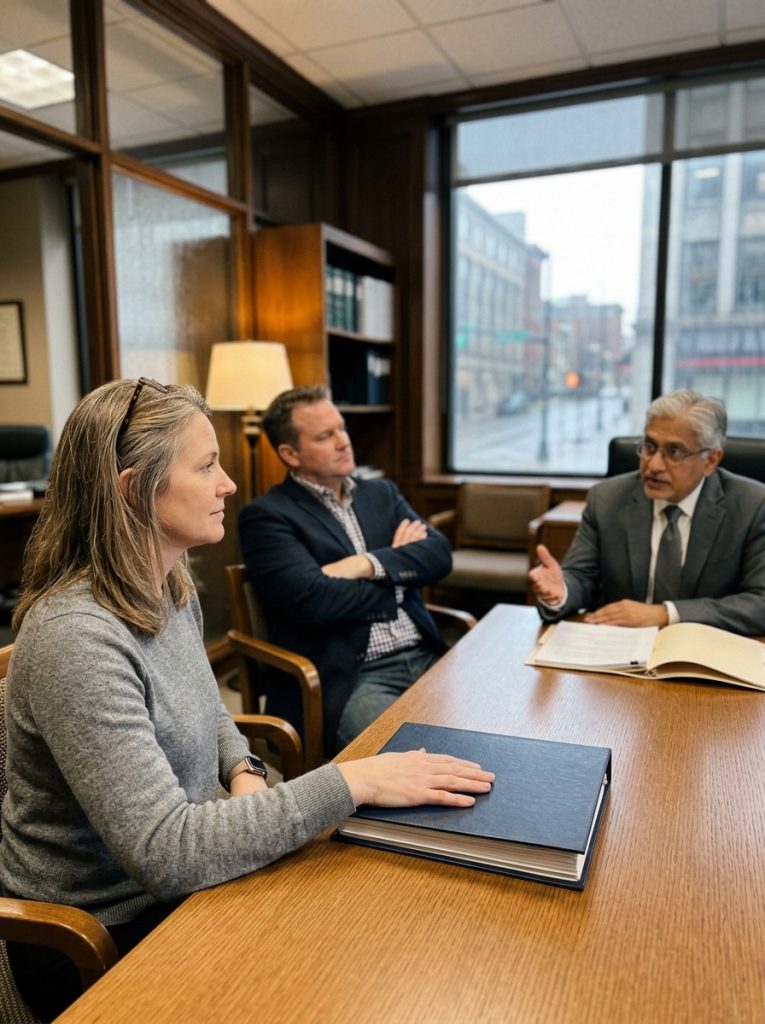
Mr. Shah opened the binder. He’s an estate lawyer; he’s seen a lot of families at their worst. But I watched his eyebrows go up as he turned the pages.
It was three years of my mother’s care, documented day by day. The home-health agency’s official visit logs, signed and timestamped, with my name as the family contact present at nearly every one. Appointment records from four different specialists, the sign-in sheets showing who brought her — me, me, me, down the entire column. A medication log in my handwriting, every dose, every day, three years deep. Pharmacy pickup records. The receipts for the ramp I had installed, the hospital bed, the supplies. Photos with dates. A calendar where I’d marked every overnight.
And, near the back, the visitor log from the agency, which noted family visits. Greg’s four visits were in there. Four entries in three years, against my hundreds.
Mr. Shah turned page after page in silence. Then he looked up, not at me. At Greg.
“Mr. Mallory,” he said carefully, “you stated you were the primary caregiver. These records — which are third-party, from a licensed agency, not something your sister could have fabricated — tell a very different story.”
Greg’s confident posture cracked for the first time. “Those are just — anybody can keep a binder. I was involved. I called all the time. I have a career, I couldn’t just—”
“That’s the thing, Greg,” I said quietly. “I’m not even angry that you had a career. I’m not angry that you couldn’t be here. Somebody had to earn, and somebody had to stay, and we ended up on different sides of that. If you’d walked in here and said ‘Denise did the caregiving and I want us to figure this out fairly,’ I’d have split everything with you and hugged you afterward. I mean that.”
I put my hand flat on the binder.
“What I can’t sit quietly through,” I said, “is you telling a room that you took care of our mother. Because I was the one in the room at 3 a.m. when she was scared. I was the one who held the basin. I was the one she apologized to, over and over, for being a burden, until I wanted to scream that she could never be a burden to me. You don’t get to fly in four times and then stand up in a lawyer’s office and take that from me. Not the house. The truth. You don’t get to take the truth.”
The room was very quiet.
Greg’s face did something I’d never seen it do. The confidence drained out of it page by page as Mr. Shah turned the binder. He reached for it once, to flip back, and Mr. Shah quietly slid it out of his reach and said, “I’d like to finish reviewing it first, if you don’t mind.”
“Anybody can keep records,” Greg tried again, but his voice had lost its certainty. “I was there in the ways that counted. I called. I—”
“You called,” I agreed. “On Sundays. For about twenty minutes. And I was grateful for those calls, Greg, because after I’d hang up, Mom would be happy for an hour, and an hour of Mom being happy was worth a lot to me.” I kept my voice level. “But you can’t call something into existence that you didn’t do. I’m not asking you to feel guilty for having a life far away. I’m asking you to not stand in a lawyer’s office and take credit for three years of my life to your face.”
Then Mr. Shah did something I didn’t expect. He reached into his own folder and took out an envelope.
“Your mother left this with me,” he said, “to be read if there was a dispute about the house. She told me she hoped there wouldn’t be.” He opened it and read aloud.
It was my mother’s voice, in her shaky late handwriting. She wrote that she knew exactly who had cared for her. She named it plainly — the nights, the appointments, the basin. She wrote that she loved both her children but that she would not insult her daughter’s three years by pretending they hadn’t happened. She left the house to me.
And then she wrote one more line, the one that broke me and, I think, broke Greg too. She wrote: “Greg, I never needed your visits to know you loved me. But I needed your sister’s hands to live. Don’t take from her what she gave to me. Be the brother she deserves now, because she’s going to be alone in that quiet house, and she’ll need you to finally show up.”
Greg put his face in his hands.
I’d braced for a fight. For lawyers and appeals and a brother who’d burn the family down over square footage. Instead my big, confident brother sat in that office and cried like the little boy I grew up with, and said, “I’m sorry. God, Denise, I’m so sorry. I told myself the checks and the calls were enough. I think I knew they weren’t. It was easier to believe the version where I was the good son.”
Here’s the part I’m proudest of, and it’s not the binder.
I kept the house. Mom wanted me to have it, and I’d earned it, and I’m done apologizing for saying so. But I didn’t use the binder to punish my brother. Once the truth was on the table — really on the table, in Mom’s own words — I didn’t need him to suffer. I needed him to see me. He did.
We’re closer now than we’ve been since we were kids, which is the strangest gift to come out of all this. Greg flies in more than four times a year now. He helped me clear out Mom’s things, and we cried and laughed over her ridiculous Christmas-sweater collection, and he finally heard the stories of those three years — the hard ones and the tender ones — instead of skipping past them to the part where he felt like a good son.
He told me, on the porch one evening, “You did the thing I was too scared to do. I told myself I was busy. The truth is I couldn’t face watching her get smaller. You faced it every single day.” He shook his head. “The binder didn’t change my mind, Denise. The binder just made me admit what I already knew.”
The reconciliation took time, and it took Greg doing the work, not just saying the words. He started flying in more than four times a year. He helped me clear out Mom’s closets, and we laughed and wept over her ridiculous Christmas-sweater collection, and for the first time he sat still long enough to hear the real stories of those three years — the 3 a.m. fears, the small jokes, the way she’d hum when I brushed her hair. He’d skipped all of it to protect himself from watching her get smaller. Hearing it now was his penance, and he took it. “You did the thing I was too scared to do,” he told me once, on the porch. “I hid behind being busy. You just showed up, every day, and let it cost you.” That was the apology that actually landed.
I still live in Mom’s house. I kept her kitchen mostly the way she had it. Some mornings I make coffee and I swear I can feel her in the next room, and it’s not sad exactly, it’s just full.
People hear this story and they want it to be about a sister winning a house. It isn’t, really. The binder was never a weapon. It was just the careful record of love — three years of it, written down by the daughter who stayed, because somebody in the chaos has to keep the records.
I kept them.
And when it mattered, every single page had my mother’s care in it, and not one of them needed me to say a cruel word. The truth, squared neatly in a binder, said all of it for me.