The Paperwork That Exposed My Husband’s Desperate Scheme
The second warrant was for Julian’s office, and the detective did not explain much before leaving.
He didn’t need to.
My lawyer, Mr. Vance, closed the folder on his lap and looked at me for a long moment. “You need to understand something, Clara. The trust protection can stop them from touching the properties, but it cannot make what they did disappear.”
“I know.”
“Do you?”
I looked at the bandages covering my shoulder.
“Yes.”
That was the first time since the attack that I said the word without my voice breaking.
Yes.
I wanted them charged.
I wanted the truth documented.
And I wanted every piece of paper they had used to lie about me sitting in front of a judge.
The next morning, Julian’s attorney filed an emergency motion claiming I was mentally unstable and financially reckless.
Mr. Vance almost laughed when he showed me the filing.
“They’re trying to get control of your assets through the divorce before the criminal investigation catches up.”
I stared at the pages.
Julian had written that I had become “obsessive and paranoid” after my father’s death. He claimed I had refused reasonable requests to save the family business. He described himself as a husband who had been “emotionally abandoned by a difficult and increasingly hostile wife.”
There was not one sentence about the pan.
Not one sentence about the burns.
Not one sentence about the recording.
That omission told me more than the filing did.
They were still trying to win on paper.
So I decided to let them.
For the next two weeks, I stayed in a rehabilitation unit while detectives worked through Julian’s records. I learned how to move my shoulder without reopening the burned skin. I learned which pain medications made me sleepy and which ones left me clear-headed.
And I kept every document Mr. Vance sent me.
Every invoice.
Every bank statement.
Every message.
Every inspection report.
I put them into separate folders.
Julian had spent years laughing at that habit.
Now it was the only thing keeping his story from collapsing into mine.
The police discovered that the development company was deeper in debt than Julian had admitted.
Several of his newest buildings had been financed with loans that depended on projected values far above what the properties were actually worth.
When construction costs rose, the numbers stopped working.
So Julian borrowed more money.
Then more.
Eventually, he needed my buildings.
Not because they were part of his company.
Because they were the only assets valuable enough to keep his company alive.
That explained the pressure.
It did not explain the violence.
The inspection records did.
Three of Julian’s properties had passed inspections despite serious violations.
The same city inspector appeared repeatedly in the emails.
So did Eleanor.
Her messages were casual at first.
Then the language became clearer.
Dinner arrangements.
Payments.
Requests for favors.
Warnings about deadlines.
One message from Eleanor said, “The west building cannot fail again. We already paid enough.”
Another came from Julian.
“Once Clara signs, the properties cover everything.”
The detective highlighted that sentence.
I stared at it until the words blurred.
Julian had never wanted my help.
He had wanted my collateral.
There was a difference.
The handwritten note found in Eleanor’s house became the key to connecting the documents.
The bank account number belonged to a company I had never heard of.
That company had no employees, no real office, and no obvious business activity.
But it had received payments from Julian’s development company.
Those payments had then moved through two more accounts before reaching the inspector.
The paperwork did not look dramatic.
That was what made it powerful.
There were no movie-style confessions.
No single document saying, “We are criminals.”
There were dates.
Amounts.
Signatures.
Transfers.
Invoices that did not match the work supposedly performed.
And the same names appearing again and again.
By the time the divorce hearing arrived, Julian looked different.
Not older.
Just smaller.
He sat across the courtroom with Eleanor beside him.
She wore a dark suit and kept her hands folded tightly in her lap.
Julian avoided looking at my neck.
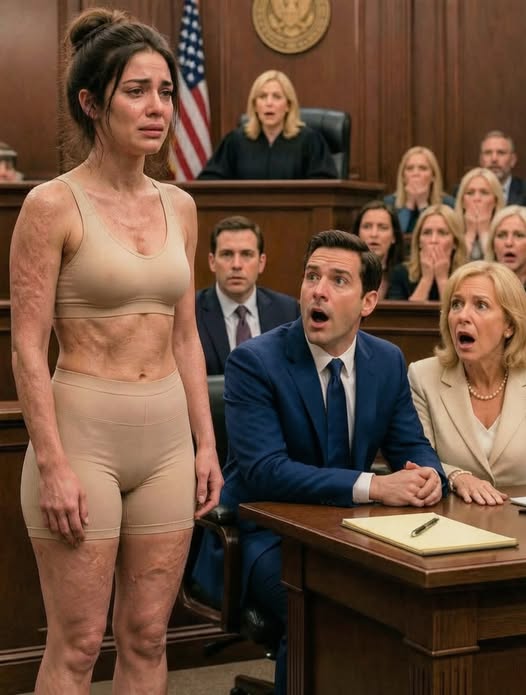
I had chosen a simple blouse that covered most of the burns.
The scars were still visible above the collar.
I did not cover them completely.
When the judge entered, everyone stood.
Then we sat.
Julian’s attorney began by describing the marriage as irretrievably broken.
He called me financially controlling.
He said Julian had been under extraordinary pressure because I refused to cooperate with his legitimate business plans.
Mr. Vance did not interrupt.
He let him speak.
Then the judge asked whether there were pending criminal allegations connected to the divorce.
Julian’s attorney hesitated.
“There is an investigation, Your Honor.”
“An investigation into what?”
Another hesitation.
“An incident involving the petitioner.”
The judge looked at me.
I nodded.
Mr. Vance stood.
“We have evidence that the incident was not accidental.”
Julian finally looked at me.
His expression was almost pleading.
I had seen that face before.
It was the face he wore when he wanted something.
The judge allowed the evidence to be entered subject to further proceedings.
The detective played the recording.
Eleanor’s voice filled the courtroom.
“After everything we did to make those inspectors approve his buildings, you still won’t save us?”
Then came the sound of the pan moving.
My own scream followed.
Then Julian’s voice.
“Maybe now you’ll understand.”
No one spoke when the recording ended.
But there was no dramatic shouting.
The judge simply looked down at the transcript.
Then she asked Julian a question.
“Did you tell emergency services that your wife spilled the oil on herself?”
Julian swallowed.
“I was in shock.”
“That was not my question.”
He looked at his attorney.
His attorney did not answer for him.
“Yes,” Julian said quietly.
The judge wrote something down.
Mr. Vance then produced the hospital recording.
Julian’s voice came through again.
“Sign the property transfer, and I’ll make sure you get the best treatment.”
This time, Julian closed his eyes.
The judge looked at him for several seconds.
“Mr. Hale, were you asking your injured wife to transfer property to you while she was receiving medical treatment?”
“I was trying to save the company.”
“That was not my question either.”
He said nothing.
The criminal case would be handled separately, but the evidence had already changed the divorce proceeding.
The financial documents made it worse.
Mr. Vance presented the loan applications.
Several carried my forged signature.
Julian had once called that a misunderstanding.
Now the documents were enlarged on a courtroom screen.
Next came the transfers.
Then the inspection reports.
Then the payments to the shell company.
Then Eleanor’s handwritten note.
The judge studied it.
“What does this bank account belong to?”
A financial investigator answered.
“A company controlled indirectly by Mr. Hale’s development business.”
“And the payments?”
“They were routed through multiple accounts before reaching an inspector.”
Julian’s attorney objected.
The investigator explained the transaction trail.
The objection was overruled.
I watched Julian’s shoulders sink.
Eleanor began whispering to her attorney.
The judge stopped her.
“Mrs. Hale, you will have an opportunity to respond.”
Eleanor looked toward me.
For the first time, I saw something different in her face.
Not guilt.
Fear.
The judge asked whether Julian had attempted to transfer any of my properties after the trust protections were activated.
Mr. Vance answered.
“He did.”
My stomach tightened.
I had not known.
“When?”
“Two days after you were admitted to the hospital.”
He placed another document on the table.
Julian had attempted to authorize a transfer involving one of the commercial buildings.
The transfer had failed because the trust restrictions were already active.
That was when I finally understood why Mr. Vance had sounded so calm on the phone.
He had not been bluffing.
He had been waiting.
Julian looked at me.
“Clara.”
I said nothing.
“I was desperate.”
I looked at the judge.
Then back at him.
“You were desperate before you poured oil on me.”
His face tightened.
“You don’t understand what was happening.”
“I understand exactly what was happening.”
He shook his head.
“I loved you.”
That sentence almost made me laugh.
Not because it was funny.
Because I remembered the hospital room.
The divorce papers beside my bed.
The smell of antiseptic.
His voice asking for my property before asking whether I could breathe comfortably.
Love had never looked like that.
The judge eventually ruled that the marital property dispute would proceed separately from my protected assets.
My inherited buildings remained outside Julian’s reach.
The court also granted the divorce.
There was no grand speech.
No satisfying moment where the judge told me I had won.
Just a series of orders.
Restrictions.
Deadlines.
Financial disclosures.
And the words I had been waiting to hear.
Julian could not use my assets to satisfy his company’s debts.
The criminal investigation continued.
Weeks later, prosecutors charged Eleanor with aggravated assault and Julian with charges related to the attack and the financial misconduct uncovered during the investigation.
The city inspector resigned before the case went to trial.
The development company collapsed.
Several investors filed civil claims against Julian.
The bank that had relied on his falsified paperwork began its own investigation.
The properties my father left me remained standing.
That mattered to me more than I expected.
My father had spent decades building those properties carefully.
He used to tell me that a building could survive a bad tenant, a bad year, even a bad manager.
What destroyed things, he said, was ignoring small cracks because they were easier to live with.
I thought about that often during the months that followed.
I stopped asking why I had stayed so long.
The answer was simpler than I wanted it to be.
I had believed paperwork was boring.
I had believed being careful was enough.
I had believed the people closest to me would not use my trust against me.
I was wrong about the last part.
But I was right about the paperwork.
The recording was not the only thing that saved me.
The old loan files mattered.
The trust documents mattered.
The bank statements mattered.
The inspection records mattered.
The emails mattered.
Each piece looked insignificant by itself.
Together, they told the truth.
My scars did not disappear.
The burns on my neck faded from angry red to a darker, uneven pattern.
Some days they hurt.
Some days they barely bothered me.
I stopped trying to decide which days were supposed to feel normal.
A year after the attack, I stood in the lobby of one of my father’s buildings while a contractor repaired a damaged section near the entrance.
The smell of fresh paint filled the air.
For a moment, I remembered the kitchen.
The iron pan.
The steam.
The tile against my cheek.
Then I looked at the folder in my hand.
It was the same folder Mr. Vance had given me at the hospital.
The edges were worn now.
The pages inside were covered with notes, dates, and signatures.
I closed it.
My phone buzzed.
A message from Mr. Vance.
The final settlement documents had been filed.
I stood there for a while before putting the phone away.
Outside, traffic moved along the street.
People hurried past the windows without knowing my story.
That was fine.
I did not need strangers to know what happened to me.
I only needed the truth to remain where no one could erase it.
I placed the folder inside my father’s old filing cabinet.
Then I locked the drawer.
The little metal key rested in my palm.
For years, I had been told that paperwork made me weak, that I cared too much about details, that I should stop worrying about signatures and dates and records.
They were wrong.
The scars were on my skin.
But the evidence was on paper.
And paper, when you keep it long enough, has a way of outlasting every lie.