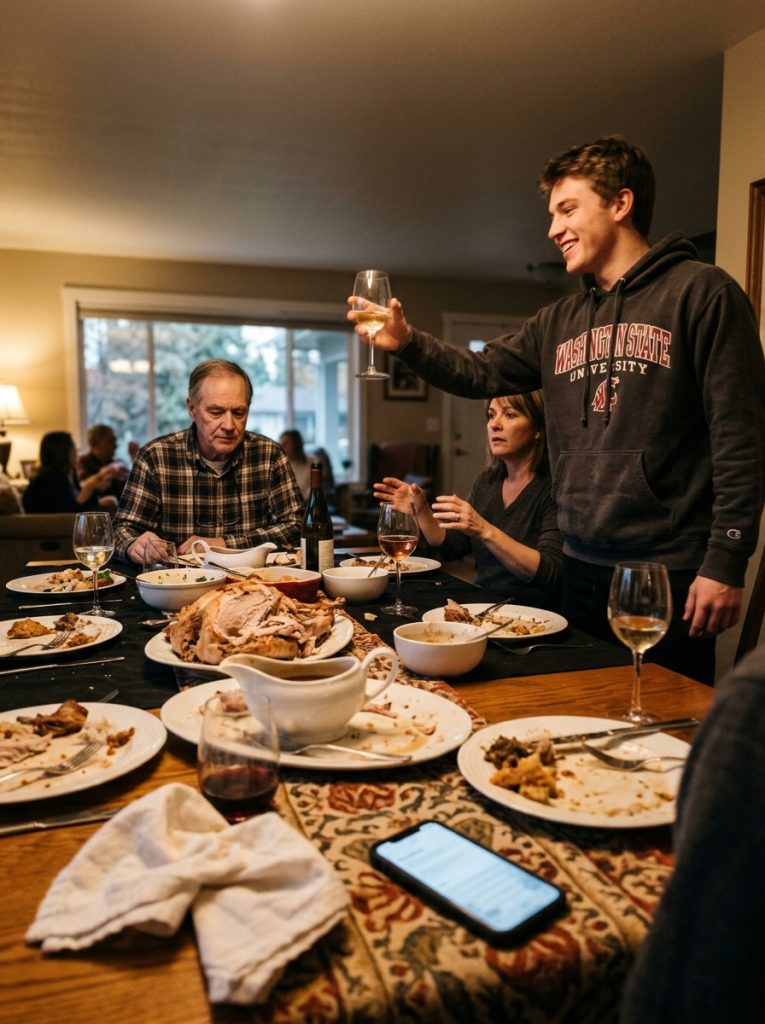
It turned out the phone wasn’t a cousin’s after all. It was Cody’s. He’d handed it to his younger cousin to film the toast, and somewhere in the kid’s fumbling, the phone had opened Cody’s saved voicemails and played one out loud.
Mine.
The table went dead silent as my own voice filled the room, eight months out of season.
“Cody, it’s Ray. Pick up, buddy. Listen — do not drive. Do not get in a car with anybody who’s been drinking, you hear me? Text me the address. I don’t care if it’s two in the morning, I don’t care how far, I’m already getting my keys. We’ll keep this between us, okay? Your mom doesn’t need to worry about it. This isn’t a lecture. Nobody’s in trouble. Just stay where you are and let me come get you. I’ve got you, son. I’ve always got you.”
The message ended. The little speaker clicked off.
Nobody at that table moved.
Because here is what only two people in the room knew, until that moment. Eight months ago, Cody — home for a weekend, at a party that got out of hand — had gotten drunk and scared and far from anyone safe. And in that moment, the moment a kid reaches for the person they trust most, he hadn’t called his mother. He hadn’t called a friend.
He’d called me.
I drove forty minutes at two in the morning and found him on a curb and put him in my truck and got him water and let him sleep it off in his old room, and in the morning I made his coffee the way he likes it and I never said a word about it. Not to Diane. Not to anyone. Because that’s the deal I’d made with myself eight years earlier. Be the one who catches him, and never, ever use it to collect.
I assumed Cody barely remembered that night. I figured the voicemail was long deleted.
He’d kept it. For eight months. On his phone. The boy who toasted “the only real parents I’ve ever had” right over the top of my head had been carrying my voice in his pocket the entire time.
For a long moment nobody at that table breathed. The voicemail hung in the air over the turkey and the good plates. My voice — gravelly, half-asleep, fierce in the way you only are at two in the morning about someone you love — saying I’ve got you, son. I’ve always got you.
Diane had her hand pressed to her mouth. She’d known about that night, vaguely — Cody had been “out late,” I’d “gone to get him” — but she’d never heard the message, never known he’d called me instead of her, never known I’d kept it from her so the boy wouldn’t get a lecture stacked on a hangover. The cousins stared at their plates. An aunt started to cry without knowing exactly why.
I looked up from my plate, and Cody was already looking at me, and his face had come apart completely. The confident nineteen-year-old who’d raised that glass was gone. He looked seven again. He looked like the boy I’d decided, eight years before, that I would protect from underneath without ever asking for the credit.
“Ray,” he said, and his voice cracked on the one syllable.
“It’s okay,” I started, the way I always start. “Cody, it’s okay—”
“It’s not.” He stood up so fast his chair scraped. The whole table flinched. “It’s not okay. I just — I stood up and I said ‘the only real parents I’ve ever had’ and I looked at Dad’s picture and I skipped you, and you just nodded, you just looked at your plate like you always do—” He was crying now, openly, the way you only cry in front of family. “You came and got me. You’ve come and got me my whole life and I never — I act like you’re not even—”
“Sit down, son,” I said gently. “Please.”
He didn’t sit down. He came around the table, past his mother, who was crying now too, and he did the thing he had not done in eight years.
He hugged me.
I want to tell you I was graceful about it. I wasn’t. Fifty-eight years old and I came apart at my own Thanksgiving table with my stepson’s arms around my neck, both of us a mess, Diane’s hand on both our backs.
When we could talk again, Cody said the thing I’ll carry to my grave. “I think I kept you at a distance,” he said, “because letting you all the way in felt like I was replacing my dad. Like I’d be telling him he wasn’t enough.” He wiped his face. “But that’s not what it is, is it. You never tried to replace him. You just… stayed. Even when I gave you nothing back. You stayed.”
“He was your father,” I said. “Nothing replaces that. I never wanted to. I just wanted to make sure that on the nights you needed someone, the phone got answered.” I held his shoulders. “It got answered, Cody. It always got answered.”
Here’s the bittersweet part, the part I think about. Eight years. Eight years I spent in the background of that boy’s life, loving him in ways he wasn’t ready to see, accepting the role of the cold stepfather at the end of the table because I thought it was what his grief needed. I’d made peace with the idea that I might be invisible to Cody forever — that I’d hold up his whole world from underneath and he’d never know my name was on it.
I’m grateful it didn’t take a tragedy to change that. It only took a glitching phone and a voicemail I forgot to be ashamed of. But I do grieve those years a little — the games I watched from where he couldn’t see me, the toasts I got skipped in, the long quiet of loving someone who didn’t know how much. I don’t regret the choice. I’d make it again. Sometimes the most loving thing you can do is stay in the dark so someone else can heal in the light. But it costs you. People should know it costs you.
In the weeks after that Thanksgiving, Cody and I did the thing we’d never done in eight years: we talked. Really talked. He told me he’d kept the voicemail because, on his hardest nights at school, he’d play it just to hear someone say I’ve got you. He hadn’t been able to say out loud that the stepfather he kept at arm’s length had become the voice he reached for when he was scared — because saying it felt like betraying the dad he’d lost at seven. I told him it wasn’t a betrayal. I told him his father and I weren’t in competition; we were on the same team, both of us trying to take care of the same kid, just from different sides of a line that death had drawn. He cried at that. So did I.
Cody calls me Dad now. Not always — he still says Ray sometimes, out of habit, and that’s fine. But that Christmas, the first card he gave me said Dad on the envelope in his handwriting, and I have it in the drawer of my nightstand, and some nights I take it out just to look at it.
Diane says she watched two stubborn men finally stop guarding their own hearts at the very same dinner table, and that she’ll never look at a quiet phone left on a tablecloth the same way again. We laugh about it now. Eight years of careful distance, undone by a cousin fumbling a camera.
He kept my voicemail for eight months.
I’ll keep that card for the rest of my life.
That’s the deal, when you love a kid from underneath. You wait a long time in the quiet, and you tell yourself the credit was never the point. And then one day a phone goes off at the dinner table, and you find out the boy was carrying your voice the whole time, right next to his heart, where his father lives too.
Turns out there was room for both of us in there.
I just had to stay long enough for him to find it.