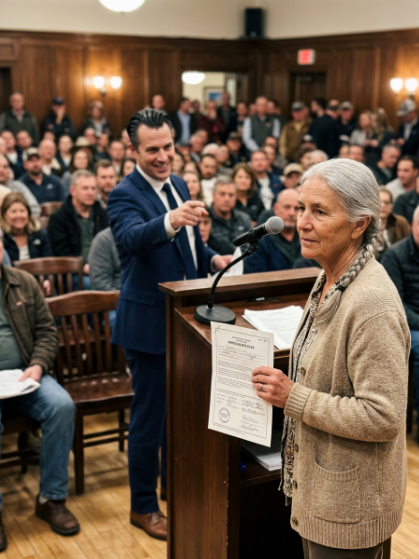
Reginald Finch, forty-five, had slicked-back black hair and a posture that screamed privilege. He had spent the last hour aggressively outbidding the local families who had farmed this valley for generations, trying to buy the historic Finch Ranch so he could demolish the old barns and build a luxury lakefront resort.
“Going once, going twice!” the auctioneer called out, his wooden gavel raised. “Sold to Mr. Reginald Finch for one point two million dollars!”
Reginald turned around to face the crowd, a smug, triumphant smirk on his lips. He spotted me standing in the back in my worn cardigan, and he pointed mockingly, his voice carrying over the murmurs of the defeated farmers.
“It’s over, Clara!” Reginald laughed, his voice loud and patronizing. “Your little preservation campaign is finished. The ranch belongs to me now. You can take your heritage archives and your sentimentality and find somewhere else to complain. The developers are starting demolition next month.”
I didn’t argue. I didn’t get angry. I simply walked slowly down the center aisle, my boots clicking softly on the floor. I reached into the pocket of my worn beige cardigan, pulled out a certified, stamped document, and placed the water rights deed flat on the wooden auctioneer’s podium right in front of the auction clerk.
“I suggest you check the county registry before you finalize the sale, Mr. Auctioneer,” I said quietly, my voice steady and calm.
Reginald scoffed, walking over to the podium. “What is this? A petition? The bidding is closed, Clara. You can’t stop the sale with a piece of paper.”
“It’s not a petition, Reginald,” I replied, pointing at the document. “It’s the certified water rights deed for this entire parcel of land. And if you read the title, you’ll see that my father transferred the water rights to my private conservancy trust ten years ago.”
The auctioneer adjusted his glasses, leaning over the podium to scan the document. His eyes went wide, and he looked up at Reginald with a sudden, serious expression.
“Mr. Finch,” the auctioneer said, his voice gravelly. “If this deed is active—and the county seal confirms it is—then the land you just bid on has no legal access to the local aquifer. The water rights are held exclusively by Clara Finch. You cannot build a resort, a house, or even draw a single gallon of water without her written permission.”
Reginald’s smirk vanished in an instant. The color drained from his face, leaving him a pasty, sickly white. He snatched the deed from the podium, his eyes wide in sudden horror as he stared at the county stamp.
“This… this is a trick!” Reginald stammered, his voice rising in panic. “The property listing said the land was fully serviced! This voids the sale! You can’t do this!”
“The listing said the land had utility easements, Reginald,” I said, looking at him with a calm, resolute expression. “But it didn’t say you owned the water. You wanted to destroy our family’s history for profit, but you forgot that a ranch is nothing without the water that feeds it. The sale is void, and the land remains with the people who actually care for it.”
Reginald stood frozen next to the podium, his hand clutching the deed, looking pale and panicked in the warm auction hall as he realized his attempt to humiliate us had just cost him his entire development plan.
The auction hall, which had been buzzing with whispers and low conversations, fell completely silent. The local farmers, who had sat with slumped shoulders and defeated looks just moments ago, were now sitting up straight, their eyes darting between Reginald’s pale face and my quiet stance by the wooden podium.
“This is ridiculous!” Reginald hissed, stepping closer to the auctioneer. “I’ve already signed the initial papers. My development group has already wired the deposit. You can’t just cancel a million-dollar auction because of some ancient easement!”
“It’s not a minor easement, Mr. Finch,” the auctioneer replied, his tone firm. He pointed to the small print on the back of the bidding registry. “Under our terms of sale, Section Nine explicitly states that all properties are sold subject to existing water rights and historical registries of record. Since you did not perform due diligence and check the county registry before bidding, the mistake is yours. However, because the parcel cannot be developed or used as a functional ranch without water access, the contract is legally frustrated. I am voiding your bid and returning your deposit.”
“You can’t do that!” Reginald yelled, his face turning from pasty white to an angry, flushed red. He slammed his hand onto the podium, his slicked-back hair falling out of place. “I will sue this auction house! I will sue you, Clara! You planned this!”
“I didn’t plan for you to be lazy, Reginald,” I said, my voice remaining quiet and level. “The water deed has been public record for ten years. You were so busy calculating your profits from the luxury lakefront resort that you didn’t bother to check the basics of the land you wanted to destroy. You assumed that because I am an old woman in a beige cardigan, I would just sit back and let you wipe out our family’s history. But this land is our heritage.”
“Mr. Finch, I must ask you to step away from the podium,” the auctioneer said, gesturing to the security guard standing at the back of the hall. “We are going to re-open the bidding for this parcel immediately, under the corrected terms reflecting the water rights restriction.”
Reginald stood shaking, his hand clutching the useless deed, looking around the room. The local farmers were staring at him, some with smirks, others with folded arms. The developer who had arrived in an expensive navy suit to buy up their valley was now completely exposed. With a bitter curse, he threw the deed onto the floor and stormed out of the auction hall, his developers trailing behind him.
The auctioneer cleared his throat, adjusting his microphone. “Ladies and gentlemen, we are re-opening the bidding for Parcel 4, the historic Finch Ranch, consisting of three hundred acres, subject to the active water rights held by the Clara Finch Conservancy Trust. Bidding will start at two hundred thousand dollars.”
The developers in the room sat on their hands. Without water access, the land was useless for commercial development, and they knew they couldn’t buy out Clara.
I raised my bidding paddle. “Two hundred thousand dollars.”
“We have two hundred thousand,” the auctioneer called. “Do I hear two hundred and fifty?”
The room remained silent. I looked around at the local farmers, and they gave me subtle, supportive nods. They knew that if I bought the land, it would remain a working ranch and a sanctuary for the community.
“Two hundred thousand once… two hundred thousand twice…” The auctioneer’s gavel hovered, then struck the wooden block with a loud, satisfying crack. “Sold to Clara Finch for two hundred thousand dollars!”
A cheer erupted from the local families. Neighbors stood up, shaking my hand and hugging me.
Today, the Finch Ranch is thriving. We didn’t build a resort. Instead, we expanded our organic farming program and opened a community center where families can learn about the history of the valley. The old barns have been restored, and the cattle still graze on the lush pastures, fed by the clean, abundant water of the local aquifer.
Reginald never returned to Lake Geneva. The developer who tried to humiliate me and take our heritage learned the hard way that true wealth is not measured in concrete and luxury resorts, but in the roots we sink into the land we love.