Here’s what Mr. Keller didn’t know.
The day they walked me out, I wasn’t the only one who thought the firing stank. There was a man on our line named Pete — quiet guy, close to retirement, the kind nobody pays attention to. Pete had been in Keller’s office a week before my termination, dropping off paperwork, when Keller took a phone call and didn’t bother to lower his voice.
Pete’s phone was in his shirt pocket, recording a voice memo for himself — a habit he had, reminders about parts and orders, because his memory wasn’t what it used to be. He’d hit record before he walked in and forgotten to stop it.
He caught the whole call.
Pete didn’t even realize what he had until weeks later, when the floor was buzzing about my “performance” firing and he remembered that conversation. He scrolled back through his voice memos, found it, and listened to his own boss say something that made his stomach turn. Then Pete, who had eight months to retirement and everything to lose, did a brave thing. He found Ms. Alvarez’s number, and he handed it over.
That recording was Exhibit B.
There was one more thing Mr. Keller didn’t know, and it’s the heart of all of this.
The recording on that little speaker hadn’t come from me. It came from a man named Pete — a quiet guy on our line, close to retirement, the kind of worker management treats like furniture. A week before they fired me, Pete had been in Keller’s office dropping off parts paperwork when Keller took a phone call and didn’t bother to lower his voice. Pete had a habit of recording voice memos to himself — reminders about orders, because his memory wasn’t what it used to be — and he’d hit record before walking in and forgotten to stop.
He caught the whole call. He didn’t even realize what he had until weeks later, when the floor was buzzing about my “performance” firing and Pete remembered that conversation and went back through his memos. Then Pete, with eight months to retirement and everything to lose, did the bravest thing I’ve ever seen a coworker do. He found Ms. Alvarez’s number, and he handed it over, and he said he’d testify if it came to that.
That was Exhibit B.
Ms. Alvarez pressed play.
The room filled with Mr. Keller’s voice. Unmistakable. Talking on the phone to someone above him.
“Yeah, it’s Price. He’s the one who filed the safety thing with the state… No, I know, but we can’t have it look like that’s why… so we build a performance file. Backdate some concerns, write him up for stuff, then let him go in a couple weeks for performance. By the book. Nobody connects it to the complaint… Yeah. We make an example out of him so nobody else gets cute about reporting things.”
We make an example out of him.
The recording kept going. Keller, on tape, instructing someone to “find things to write up” and to make sure the paper trail was “clean.” Everything the company had spent months denying — the retaliation, the manufactured performance file, the deliberate message to the rest of the floor — in his own voice, ordering it.
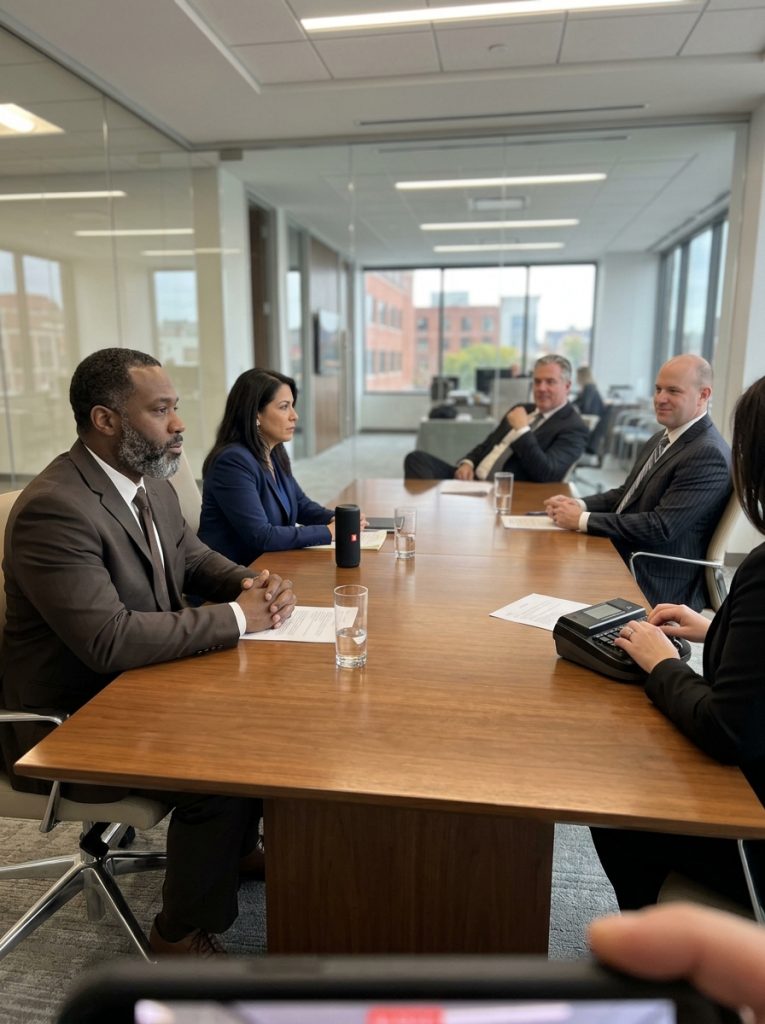
I will remember the silence in that deposition room for the rest of my life. The court reporter’s hands had stopped. The company lawyer had gone very still, the smirk wiped clean, already mentally rewriting his entire afternoon. And Mr. Keller — Mr. Keller stared at that little black speaker like it was a snake on the table.
“That’s — that recording is illegal,” the company lawyer tried. “We’ll move to exclude—”
“Ohio is a one-party consent state, counselor,” Ms. Alvarez said, calm as ever. “The gentleman who made the recording was a party to the conversation. It’s admissible. I’d be happy to brief it.” She folded her hands. “Or your client could stop pretending the timing was a coincidence.”
It didn’t matter how high-priced their lawyer was. You cannot un-ring a bell, and you cannot un-hear a man laying out a retaliation scheme in his own voice.
Keller had gone gray. He kept opening his mouth and closing it. At one point he tried, weakly, “That’s taken out of context,” and Ms. Alvarez tilted her head and said, “Then let’s play the rest of it. There’s four more minutes. Shall I?” He did not want the four more minutes. The four more minutes were worse.
His own lawyer asked for a recess, which is lawyer for we need to talk to our client about how much trouble he’s in. When they came back, the smirks were gone, replaced by the careful blank faces of men calculating exposure. The company that had spent months insisting the timing was a coincidence now had to reckon with their own executive, on tape, scheduling the coincidence.
It didn’t go to trial. Cases don’t, when the defendant’s own voice lays out the scheme. The company’s lawyers and Ms. Alvarez disappeared into a conference room, and a few weeks later we had a settlement that I’m not allowed to discuss the dollar figure of, except to say it was enough that I will never again worry the way I worried during those months of being unemployed and slandered.
But the money wasn’t the part that mattered to me. I had two conditions that weren’t about money, and I refused to sign without them.
The first was reinstatement on the record — an official acknowledgment that my termination was retaliatory and that my “performance file” was fabricated. My name, cleared, in writing. I’d given that plant eleven years. I was not going to let “let go for performance” follow me to the next interview. I didn’t go back to work there — I couldn’t, not after that — but the record now says what actually happened.
The second condition was the machine guard. The thing that started all of it. As part of the settlement, the company had to bring in an independent safety audit of the entire line, fix the violation I’d reported, and post the corrected procedures where every worker could see them. The danger that nearly took a young man’s fingers got fixed. That’s the one that lets me sleep.
There was a third thing, and it wasn’t in any contract. Pete. The quiet man eight months from retirement who handed over a recording that could have cost him everything if it had gone sideways. I asked Ms. Alvarez to make sure, as part of the deal, that there would be no retaliation against any current employee connected to the case — an ironclad clause, given what we’d just proven they did to people who spoke up. Pete made it to his retirement. We have lunch every few months. He always orders the same thing and always waves off my thanks. “You’d have done it for me,” he says. And he’s right. I would have.
People ask me if I felt triumphant, watching Keller’s smirk die when that recording played. Honestly? Not really. Mostly I felt tired, and then I felt relieved, and then — this is the strange part — I felt sad. Because Keller didn’t have to do any of it. The machine guard was a cheap fix. If he’d just listened to me eleven years in, none of this happens. He chose to make an example of me instead. He just picked the wrong man to think had nothing.
I had a quiet man with a voice memo and an attorney who talks slow.
That turned out to be plenty.