The HOA President Claimed My Family’s Lake Until The County Assessor Arrived
PART 3 (FULL STORY)
The celebration on the lawn collapsed in an instant, replaced by a wave of furious shouts and panicked murmurs that rippled through the seventy families gathered around the gate. Children stopped swimming, wading out of the water to stand beside their parents, while men in golf shirts dropped their coolers onto the grass and surged toward the monument.
“What do you mean she owns the lake?” a man in a navy polo shouted, shoving his way past the private security guard. “We paid a hundred and sixty-five thousand dollar premium for lot forty-two specifically because the sales contract guaranteed private deeded lakefront access!”
“And our family paid forty thousand dollars for our dock installation permit last spring!” a woman with a stroller cried, her voice shaking with outrage. “The HOA told us those fees went directly into the lakebed preservation fund!”
Celeste Monroe backed against the bronze monument, her manicured hands clutching her clipboard like a shield as her face turned the color of chalk. “Everyone, please remain calm! There is a minor administrative boundary discrepancy from the 1960s that our development counsel is currently resolving through the county recorder! Your lot titles are completely secure!”
“That is a lie, Mrs. Monroe,” stated Evelyn Ross, stepping forward into the center of the crowd.
Evelyn was the senior partner of the commercial real estate firm the HOA had retained for title reviews. She held a certified manila envelope and looked directly at the assembled homeowners.
“Six months ago, during the phase three platting review,” Evelyn announced in a clear, measured voice, “my firm completed the chain-of-title search for Juniper Hollow. We informed Mrs. Monroe in writing that the 1968 severance agreement permanently separated the upland residential hayfields from Parcel 04-B—the one-hundred-and-eighty-acre lakebed, shoreline easement, and water reservoir owned by the Walker estate.”
Evelyn turned toward Celeste, her expression devoid of pity. “I advised Mrs. Monroe that neither the developer nor the HOA had any legal authority to grant lake access, permit dock construction, or assess lake maintenance fees. Mrs. Monroe terminated our retainer, ordered the title opinion suppressed from the board minutes, and continued selling waterfront parcels using fraudulent title riders.”
A roar of indignation erupted from the crowd. Several homeowners began filming Celeste with their phones, shouting demands for an immediate refund.
The water-division enforcement officer, Officer Bradley, walked to the head of the main pier, pulling out a roll of heavy yellow state warning tape.
“By order of the Colorado Division of Water Resources,” Officer Bradley announced through a megaphone, “this body of water is closed to all unpermitted recreational use. Every dock structure attached to this shoreline constitutes an illegal trespass and unpermitted encroachment on private waters. Anyone entering this reservoir without express written authorization from the deed holder will be cited for criminal trespass.”
Two county sheriff cruisers pulled through the front gate, their red and blue light bars flashing against the lakeside trees. Sheriff Miller stepped out of the lead cruiser, accompanied by a senior investigator from the State Attorney General’s Consumer Fraud Division.
The investigator walked straight up to Celeste, presenting a signed judicial warrant. “Celeste Monroe, you are a forty percent shareholder in Juniper Hollow Development Group LLC. State financial audits show that over nine million dollars in fraudulent waterfront lot premiums and unpermitted dock fees were diverted into private holding accounts under your personal signature.”
Sheriff Miller took the clipboard from Celeste’s trembling hands and pulled her arms behind her back. The steel handcuffs clicked with a sharp, final snap in front of the seventy families she had spent three years manipulating.
“You have the right to remain silent,” Sheriff Miller recited, guiding the pale, silent HOA president toward the back of the cruiser.
As the police car drove away through the gates, a heavy, suffocating silence settled over the homeowners. Fathers looked at their brand-new docks, mothers looked at their children, and the reality of the situation set in. Without legal water rights, their multi-million-dollar dream homes were facing catastrophic property devaluations, legal injunctions, and clouded titles.
The man in the blue polo turned toward me, his hands raised in a desperate, pleading gesture. “Ms. Walker… we had no idea. We were lied to by the developer from the day we signed our purchase agreements. We sank our life savings into these houses. Please don’t fence off the lake.”
I stepped onto the base of the bronze monument, looking out at the crowd of families. I saw young couples holding their children, retired teachers who had bought what they believed was their forever home, and honest people who had been used as pawns by an arrogant developer.
“My father, Thomas Walker, lived on this land for seventy-six years,” I said, my voice carrying across the quiet lawn. “He spent forty-two years paying every cent of taxes on this lakebed, stocking these waters with trout, planting the willow trees along the banks, and guarding this water so it would remain clean and alive.”
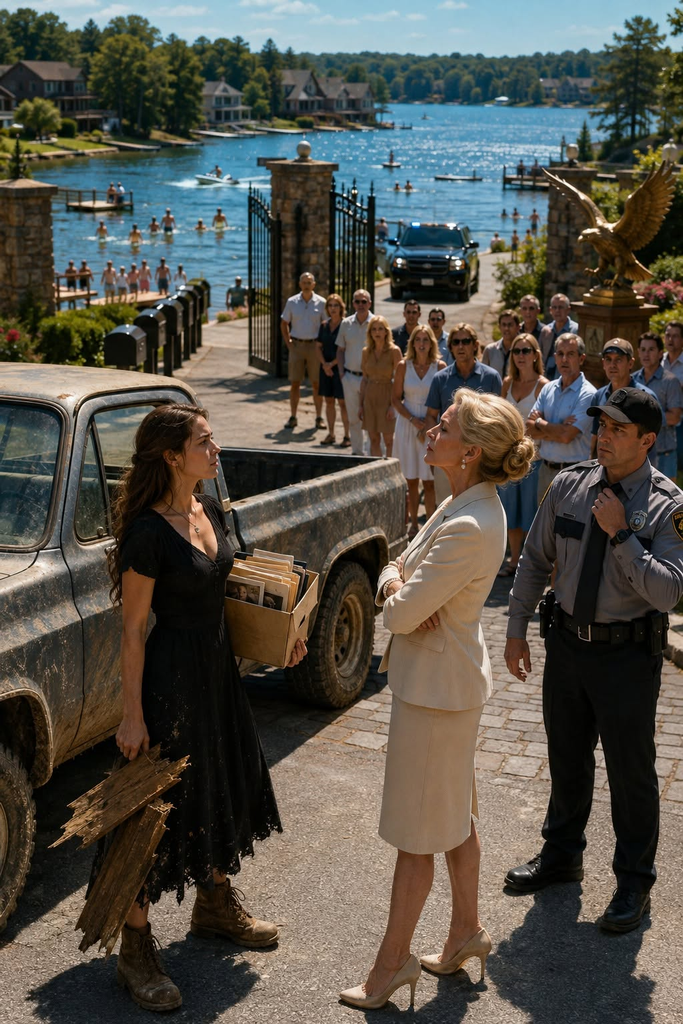
I paused, looking at the split cedar sign resting on the hood of my truck.
“When my father died eleven months ago, the developer bulldozed his cabin, dumped his hand-carved sign in a ditch, and told everyone he was an abandoned caretaker. They tried to erase his name so they could sell you a lie for profit.”
I looked back at the homeowners.
“I didn’t drive five hundred miles from Montana to punish seventy innocent families for a developer’s greed,” I continued. “I came here to ensure my father’s legacy was respected.”
I pulled a document from my legal file box and held it up.
“My attorney and I have drafted the framework for the Thomas Walker Conservation Trust,” I announced. “Under this trust, the lakebed and water rights will remain permanently protected from commercial development. In exchange for removing the unpermitted private docks and establishing natural shoreline preservation buffers, every family currently residing in Juniper Hollow will receive a permanent, deeded recreational access easement at zero cost.”
The crowd stood stunned for a moment, unable to believe what they were hearing. Then, a wave of heartfelt applause and collective relief broke across the lawn. Several mothers wiped away tears, and homeowners stepped forward to shake my hand, offering profound apologies for how my father had been treated.
“There is only one condition,” I added, smiling faintly.
The crowd went quiet, listening intently.
“The bronze monument comes down today,” I said. “And this water is officially and permanently returned to its rightful name: Walker Lake.”
Within an hour, three homeowners brought out heavy tools and crowbars, helping me dismantle the developer’s bronze plaque from the stone monument.
Over the next six months, the legal system dismantled the remnants of the fraudulent development group. Celeste Monroe was convicted on multiple felony counts of grand larceny, real estate fraud, and deceptive trade practices, receiving a seven-year prison sentence. The state court ordered the full restitution of eleven million dollars from the developer’s seized assets to the homeowners, completely reimbursing them for their dock costs and fraudulent premiums.
The community rallied around the new conservation trust, working side by side with local environmental groups to restore the natural reeds and wild grasses along the water’s edge.
On a warm summer morning six months later, I walked down the gravel path to the edge of the lake. The morning mist was rising off the glass-like water, carrying the fresh scent of pine and mountain air.
At the main entrance road stood a magnificent new cedar sign, carved deep into seasoned wood and sealed against the mountain weather:
WALKER LAKE — PRESERVED FOR THE COMMUNITY IN MEMORY OF THOMAS WALKER.
I walked out onto the simple wooden fishing pier my father had built forty years ago, holding his vintage fly rod in my hand. A gentle breeze rolled across the water, carrying the sound of children laughing as they skipped stones from the public beach down the shore.
I cast my line into the golden morning light, watching the ripples spread peacefully across the surface. My father’s name had not been erased. It had become the foundation of a community that would protect his water for generations to come.