The Quiet Wife Who Secretly Owned the Company Her Husband Claimed to Build
PART 3 (FULL STORY)
“Mine.”
The word settled over the courtroom with more force than I expected.
Judge Calder looked down at the incorporation documents again. His finger rested beside the second signature, the ink slightly faded after all these years but still unmistakable.
“Mrs. Lane,” he said carefully, “I need you to explain exactly what this means.”
Adrian stood so quickly that his chair scraped against the floor.
“Your Honor, this is absurd.”
Judge Calder didn’t look at him.
“Mr. Hollis, sit down.”
Adrian sat.
For the first time since I had known him, he looked less like the powerful CEO whose photograph appeared in business magazines and more like a man who had just discovered that the ground beneath him wasn’t where he thought it was.
I opened the black notebook.
“I signed the incorporation documents twelve years ago,” I said. “The company was not called Hollis Transit Systems then. It was called Lane Logistics.”
A murmur moved through the gallery.
Adrian’s attorney immediately objected.
“Your Honor, whatever Mrs. Lane claims about a company created years ago is irrelevant to the present divorce proceedings.”
Judge Calder turned toward him.
“You may object after she finishes explaining why the original incorporation papers were just placed before this court.”
The attorney sat down.
I looked at my sons.
They were still holding hands.
I wanted them to hear the truth, but I didn’t want them to carry the ugliness of their parents’ marriage for the rest of their lives.
So I spoke slowly.
“Before Adrian and I were married, I worked in transportation finance. I wasn’t famous. I wasn’t interested in being famous. But I understood something about regional freight that most people in our area didn’t.”
I turned another page in the notebook.
“Small carriers were failing because they couldn’t compete with the large national networks. I believed they could survive if they shared routes, maintenance facilities, fuel contracts, and technology.”
Judge Calder listened.
“So I built a company around that idea.”
“Lane Logistics,” he said.
“Yes.”
Adrian’s jaw tightened.
I continued.
“The first capital came from my father’s estate. Not enough to make me wealthy, but enough to build the first network. I recruited drivers. I negotiated contracts. I designed the operating model. And I incorporated the company under my name because I had no reason to believe I would ever need to hide it.”
Adrian finally spoke.
“You had no idea what you were doing.”
I looked at him.
“I knew enough to build a company you wanted.”
That landed differently.
Several reporters began writing.
Adrian’s attorney stood again.
“Your Honor, even if Mrs. Lane founded an early company, she has not established that it is the same entity as Hollis Transit Systems.”
“That’s fair,” Judge Calder said.
He looked at me.
“Can you?”
I reached into the handbag.
The leather had been scratched along one corner for years. Adrian had once told me to replace it because it made me look cheap.
I had kept it anyway.
Inside was another folder.
“This is the merger agreement from our third year.”
Judge Calder opened it.
“Lane Logistics acquired Hollis Freight Services.”
“Yes.”
Adrian leaned forward.
“That was my company.”
“No,” I said. “It was your father’s company.”
The room shifted.
Adrian’s father had died six years earlier.
Everyone in that courtroom knew his name.
He had been the reason Adrian entered the transportation industry in the first place.
Adrian’s attorney frowned.
“Mrs. Lane, you’re saying Mr. Hollis never owned Hollis Freight Services?”
“I’m saying his father did.”
“And what happened to the company?”
“It was heavily indebted.”
Adrian looked at me with something close to hatred.
I remembered that expression.
I’d seen it years earlier, the first time I told him that his father’s company was too unstable to survive without restructuring.
He had laughed at me then.
He had called me cautious.
He had said I worried too much.
Three months later, he came to me asking for help.
I gave it to him.
Not because I trusted him completely.
Because I loved him.
That was the part I had spent the longest trying to forgive myself for.
I had merged the companies.
Then I had given Adrian operational control.
I kept majority ownership.
At the time, I believed marriage meant building something together.
Adrian believed marriage meant eventually getting everything.
The difference took twelve years to become visible.
Judge Calder examined the documents for several minutes.
Then he looked at Adrian.
“Mr. Hollis, when did you first learn that Mrs. Lane retained majority ownership?”
Adrian didn’t answer.
His attorney whispered something.
Judge Calder repeated the question.
“I don’t remember,” Adrian finally said.
I almost smiled.
“You remember.”
He looked at me.
“You told me the papers were temporary.”
“No.”
“You said you would transfer the shares.”
“I never said that.”
“You promised.”
“I promised to consider it.”
His face changed.
Because he remembered.
So did I.
We had been sitting at our kitchen table before we were married. He had held my hand and told me that once the company stabilized, we would restructure everything together.
I believed him.
I never signed the transfer.
The shares remained mine.
The company grew.
And Adrian became its public face.
At first, that arrangement worked.
He was good at speaking to investors.
He was good at interviews.
He was good at walking into a room and making people believe he had already won.
I was better at numbers.
I understood contracts.
I understood debt.
I understood where the company was vulnerable.
So while Adrian gave interviews, I sat in quiet offices reviewing acquisition proposals.
While he attended charity dinners, I negotiated with lenders.
While magazines called him a visionary, I was the person reading every clause before he signed anything.
Then he started coming home later.
Then he stopped asking what I thought.
Then he began introducing me as “my wife.”
Not “my partner.”
Not “the woman who built this with me.”
Just my wife.
I didn’t fight him over the title.
I thought the truth would eventually matter more than the story.
I was wrong about how long I would have to wait.
Judge Calder turned toward the boys.
“Mrs. Lane, are the children aware of any of this?”
“No.”
“Why bring them today?”
I looked at Samuel and Owen.
“Because Adrian told them I had abandoned them.”
Adrian shook his head.
“I never said that.”
“You told them I didn’t work.”
“I told them their mother chose not to work.”
“That’s not the same thing?”
His voice sharpened.
“No.”
I opened the black notebook and removed a page.
“Then perhaps we should listen to the recording.”
Adrian froze.
His attorney turned toward him.
Paige looked frightened.
I had recorded the conversation legally. I had kept it because I knew that one day Adrian might try to make the boys believe his version of events.
The recording played through the courtroom speakers.
Adrian’s voice filled the room.
“Your mother doesn’t have anything. She doesn’t work. She doesn’t own anything important. When the divorce is final, you’ll live with me.”
Then Paige’s voice.
“She’ll have nowhere to go.”
The recording stopped.
Samuel looked at his father.
“Why did you say Mom doesn’t work?”
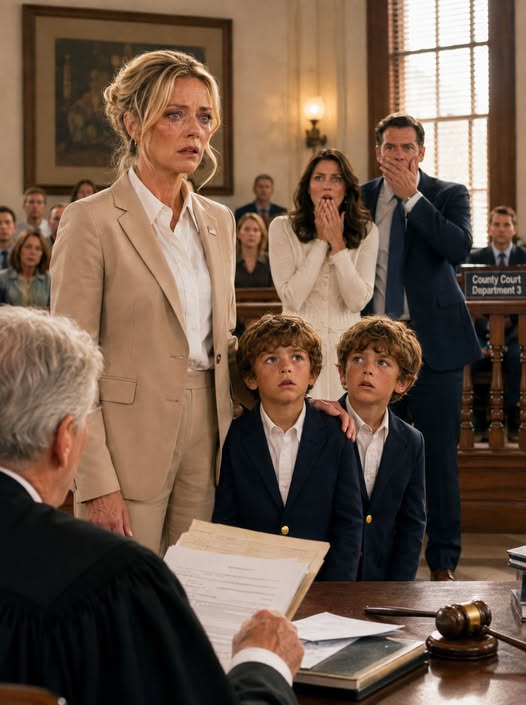
Adrian opened his mouth.
Nothing came out.
I put my hand on Samuel’s shoulder.
“I worked differently,” I told him.
Owen frowned.
“Why didn’t you tell us?”
“Because I wanted you to have a normal childhood.”
He thought about that.
“Are you rich?”
A few people in the gallery almost laughed.
I shook my head.
“I’m comfortable.”
That answer made Judge Calder smile faintly.
Adrian’s attorney cleared his throat.
“Your Honor, ownership of a corporation does not automatically determine custody.”
“I agree,” Judge Calder said. “Which is why we’re going to separate the issues.”
He turned toward me.
“Mrs. Lane, do you have evidence regarding the children’s care?”
I nodded.
I had school records.
Medical records.
Their teachers’ statements.
Their schedules.
Everything I had quietly collected over the years because I had always been the one taking them to appointments, attending school meetings, helping with homework, and staying awake when one of them had a fever.
Adrian had photographs.
I had the actual calendar.
The custody argument changed quickly after that.
Not because I destroyed him.
Because the truth was ordinary.
The boys knew who packed their lunches.
They knew who attended their school plays.
They knew who waited outside the nurse’s office.
They knew who was there.
The judge didn’t need a dramatic speech.
He needed facts.
By the end of the afternoon, Judge Calder ordered temporary primary custody to remain with me and restricted Adrian’s unsupervised access until a full custody evaluation could be completed.
Then came the issue Adrian had been trying hardest to avoid.
The company.
Judge Calder looked through the corporate records again.
“These documents appear to establish that Mrs. Lane retained controlling ownership.”
Adrian’s attorney protested.
“Your Honor, we need additional time to review the corporate structure.”
“You will have it.”
The judge looked toward Adrian.
“But until ownership is resolved, I see no basis for treating Mr. Hollis as the sole owner of the company’s assets in this proceeding.”
Adrian’s face went blank.
His empire had not disappeared.
But for the first time, it was no longer entirely under his control.
The reporters rushed toward the courthouse doors as soon as the hearing ended.
Questions followed me.
“Mrs. Lane, did you secretly build Hollis Transit?”
“Why did you let your husband take credit?”
“Are you taking control of the company?”
“Did Adrian know you owned it?”
I ignored all of them.
Outside, the rain had stopped.
Samuel and Owen walked beside me.
Adrian came out several minutes later.
Paige followed him.
She looked different now.
Not glamorous.
Not confident.
Just tired.
“Adrian,” she called.
He didn’t turn around.
She grabbed his arm.
“What happens to us?”
He pulled away.
“I don’t know.”
She stared at him.
For twelve years, I had watched Adrian turn every uncertainty into somebody else’s problem.
Now there was nobody left to blame.
That night, I took the boys home.
They were exhausted.
Samuel fell asleep on the couch before dinner.
Owen sat beside me at the kitchen table.
“Mom?”
“Yes?”
“Are you still going to be our mom tomorrow?”
I looked at him.
“Every tomorrow.”
He nodded.
That was enough for him.
Later, after they were asleep, I went into my office.
For years, the room had been almost empty.
A desk.
A lamp.
The old leather handbag.
Nothing that suggested the person who sat there had ever founded a transportation company.
I opened the handbag and took out the original incorporation papers.
The first page was worn along the edges.
My younger signature sat beneath the company name.
Lane Logistics.
I remembered the woman who had signed it.
She had been twenty-eight.
She had been ambitious.
She had believed that love and business could coexist.
She had believed that giving someone power did not mean giving away yourself.
I had spent years hiding that woman.
Not because I was ashamed of her.
Because Adrian had taught me that being visible came with a price.
Now I placed the documents on the desk.
The next morning, I called the company’s general counsel.
“I want an emergency board meeting.”
There was a pause.
“Are you sure?”
“Yes.”
“What should I tell them?”
I looked through the office window.
The rain had left the streets shining beneath the morning light.
“Tell them the founder is finally coming back.”
The board meeting lasted four hours.
Some directors were shocked.
Some were embarrassed.
A few admitted they had always suspected there was more behind the company’s structure than Adrian had told them.
Nobody resigned immediately.
Nobody applauded.
It wasn’t that kind of story.
People simply began asking questions.
Who had approved the acquisitions?
Who had signed the original financing agreements?
Who had negotiated the debt restructuring?
Who had personally guaranteed the early loans?
The answers were sitting in boxes of old documents.
My name appeared again and again.
Not as Adrian’s wife.
As the person who had built the foundation.
The board eventually voted to remove Adrian as CEO pending an independent investigation into his financial decisions and representations regarding company ownership.
I did not celebrate.
I didn’t want revenge.
I wanted the company protected from the man who had spent years treating it like an extension of his ego.
The investigation uncovered more than I expected.
There had been unauthorized transfers.
Personal expenses disguised as corporate costs.
Deals approved without proper disclosure.
Nothing dramatic enough to make a movie.
Just a long trail of small decisions made by someone who had grown certain nobody would ever challenge him.
Adrian’s lawyers eventually negotiated a settlement.
He kept a minority financial interest that was legally his.
He lost operational control.
He lost the title he had built his identity around.
And he lost the ability to tell people that I had contributed nothing.
The divorce took months.
The prenup mattered.
I never pretended it didn’t.
There were things I could not simply take because I had founded the company.
There were things Adrian had earned.
There were things we had accumulated together.
So we divided what needed to be divided.
The difference was that this time, everything was decided with complete information.
No hidden accounts.
No false statements.
No carefully constructed story.
Just documents.
Facts.
Signatures.
At the final hearing, Judge Calder reviewed the settlement.
Then he looked at me.
“You seem different from the woman who entered this courtroom months ago.”
I thought about that.
“I am.”
He smiled.
“Good.”
The divorce was granted.
Adrian didn’t look at me when he walked out.
Paige was no longer beside him.
I never learned exactly when their relationship ended.
I didn’t need to.
Some endings don’t require witnesses.
A year later, Hollis Transit Systems was still operating.
The name remained because changing it would have cost millions and disrupted contracts.
But the company had changed.
The board changed.
The culture changed.
And the founder’s office changed.
I didn’t put my name on the building.
I didn’t give interviews about Adrian.
When journalists asked why I had stayed silent for so long, I gave them the same answer.
“Because silence was useful until it wasn’t.”
One afternoon, Samuel and Owen came to the office after school.
They were ten now.
They ran down the hallway arguing about who would get to sit in my chair.
I watched them from the doorway.
“You two know that’s my chair, right?”
Samuel grinned.
“You have another one.”
Owen laughed.
For a moment, the office didn’t feel like a headquarters.
It felt like home.
After they left, I returned to my desk.
The old leather handbag sat beside the lamp.
The same one I had carried into Courtroom Four.
The same one Adrian had dismissed as cheap.
I opened it.
Inside was the original incorporation document.
I ran my fingers over the faded signature.
Then I closed the folder and placed it back inside.
The document had never been a weapon.
It had simply been proof.
Proof that the quiet woman everyone had underestimated had been there from the beginning.
Outside my window, trucks moved along the highway in a steady stream, carrying freight across the same roads I had once studied on a paper map at a kitchen table.
I watched them disappear into the distance.
Then I picked up the handbag, turned off the office light, and went home to my sons.
For twelve years, Adrian had told everyone I had given up everything for him.
He was right about one thing.
I had given up a lot.
But I had never given up who I was.