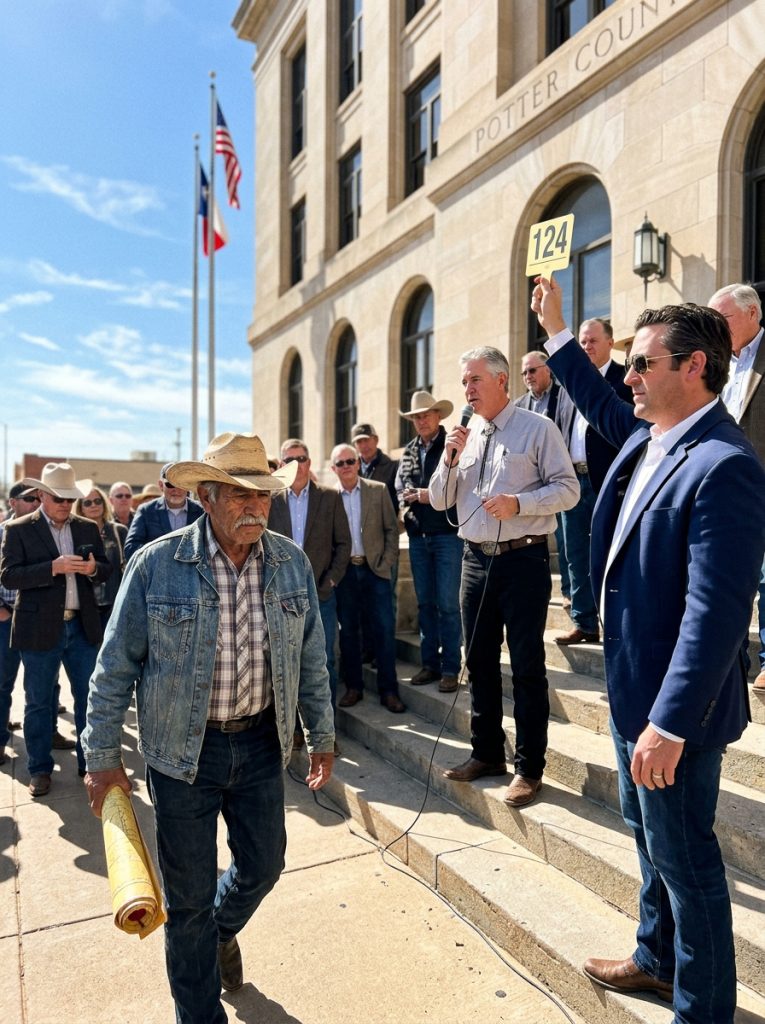
The clerk’s rep said “the filing is valid” and the courthouse steps went quiet enough to hear the flags on their poles doing nothing in the still Texas air.
Brad Kinney lowered his paddle. Slowly. Like it weighed something it hadn’t weighed thirty seconds ago.
I stood there with the map unrolled between my hands — yellowed paper, hand-drawn lines, the 1927 water-rights deed attached at the bottom with a brass fastener my grandfather had pressed into place ninety-seven years earlier.
Nobody spoke for what felt like a long time.
Then one of Brad’s guys — navy polo, leather loafers, clearly not from Amarillo — pulled Brad aside and whispered. I couldn’t hear what he said, but I saw Brad’s jaw tighten. Then his shoulders drop.
He turned back to the auctioneer.
“Is the sale voided?”
The auctioneer looked at the clerk’s rep. She shook her head.
“The sale cannot proceed without consent of the senior water-rights holder. Without that consent, title insurance will not certify, and no lender will finance a purchase.”
Brad looked at me.
For the first time since I’d walked up those steps, he really looked at me. Not like I was an interruption. Not like I was a sad old man who’d wandered into the wrong event. He looked at me like I was a problem.
“Mr. Delgado,” he said. “Can we talk?”
“We can talk right here,” I said.
He glanced at the crowd. Fifteen people watching. A newspaper photographer from the Amarillo Globe-News who’d come to cover the auction was taking pictures.
“I could offer you—”
“No.”
He stopped.
“I’m not selling my water rights,” I said. “I’m not leasing them. I’m not licensing them. This land has been in my family for three generations. My grandfather dug the well. My father ran cattle on it. I raised my children here. It’s not a commodity. It’s home.”
Brad’s guys exchanged looks.
“The tax debt—” one of them started.
“Is $23,400,” I said. “I know exactly what it is. And I plan to pay it.”
Brad almost laughed. “With what?”
I rolled the map back up. Carefully. The paper was old and I’ve been gentle with it my whole life.
“That’s between me and the county,” I said.
And I turned around.
I walked back down those limestone steps. My boots on stone. The sun directly overhead. My shadow small and tight beneath me.
Behind me, I heard the auctioneer say: “The sale is hereby postponed pending resolution of the title encumbrance. Thank you for coming.”
I crossed the street. I sat down on the bench where I’d been sitting all morning. I put my hat on my knee. I held the map across my lap.
And I breathed.
I’ll be honest — my hands were shaking. Not from fear. From relief. From the weight of ninety-seven years of family history doing its job in sixty seconds.
My lawyer had told me it might work. He’d found the deed in the Potter County Clerk’s office three weeks earlier — filed in 1927, never contested, never transferred. Senior water rights. The oldest on record for the Ogallala aquifer access beneath my ranch.
“If it’s still valid,” he’d said, “no one can buy that land without your say-so. Not the county. Not a developer. Not God himself.”
It was still valid.
I sat on that bench until the crowd dispersed. Brad and his group got into their rental SUV and drove away. The auctioneer packed his microphone. The clerk’s rep nodded at me as she walked to her car.
Just me and the courthouse.
My phone rang. It was my daughter, Elena, calling from Austin.
“Papa? How did it go?”
“We still have the ranch,” I said.
She screamed. Not words — just sound. Joy and relief compressed into a single note that made me smile for the first time in months.
“Now we need to pay the taxes,” I said.
“I know, Papa. I’ve been looking into it.”
Elena works in finance. She’d been running numbers since the moment I told her about the auction. She’d found a state program — the Texas Agricultural Tax Deferral — that allows working ranch land to defer delinquent taxes into a five-year installment plan at 2% interest.
The total monthly payment would be $412.
I can do $412. Barely. But I can do it.
We filed the application the next day. Elena drove up from Austin that weekend with the paperwork already filled out. She sat at my kitchen table — the same table her mother used to roll tortillas on before she got sick — and she walked me through every page.
The county approved it in nine days.
Nine days.
After two years of certified letters and threats and an auction on the courthouse steps — nine days.
The ranch stays.
Brad Kinney’s company sent me a letter two weeks later. An offer. They wanted to buy the water rights separately — $1.2 million for a ninety-nine-year lease.
I didn’t even read the full page.
I wrote “NO” on the back of the envelope and mailed it back.
Elena laughed when I told her. “Papa, you could have at least read the offer.”
“I did read it. It said they want to take my water and build houses where my cattle sleep. That’s all I needed to know.”
She shook her head. But she was smiling.
The ranch is quiet now. Same dust. Same mesquite. Same well that never runs dry. I fixed the fence on the south pasture last week. My grandson — Elena’s boy, Diego, thirteen — helped me stretch the wire. He’s strong for his age. Quiet like his grandmother was.
When we finished, we sat on the tailgate of my truck and drank Gatorade and looked out over the land.
“Grandpa,” he said. “Is this really all ours?”
“Three generations,” I said. “Your great-great-grandfather built the house. Your great-grandmother cooked in that kitchen. Your grandmother grew roses by the front porch. And one day it’ll be yours.”
He nodded. Like he understood the weight of that.
Advertisement
Maybe he does.
I keep the survey map in a fireproof safe now. The 1927 deed. The wax seal. The hand-drawn lines my grandfather traced with a pencil he sharpened with a pocketknife.
It saved us.
Not money. Not lawyers. Not luck.
Paper. History. A man who thought ninety-seven years into the future and filed one document in a county courthouse that said: this water belongs to my family.
And it still does.
The Globe-News ran a story the following week. Front page of the local section. Photo of me walking up those courthouse steps with the map in my hand. Headline: “Delgado Water Rights Halt Foreclosure Auction.”
I got calls from people I hadn’t heard from in years. Old friends. Neighbors. A cousin in El Paso who’d seen it online.
They all said the same thing: “We didn’t know you had that paper.”
I didn’t tell many people. My whole life, I kept quiet about the deed. My father told me about it when I was sixteen. He said: “This paper is your last defense. Don’t use it until you have to. And don’t tell anyone you have it until the moment they need to know.”
I waited sixty-eight years.
And the moment came on a Tuesday morning in June on limestone steps with the sun beating down and a developer from Dallas raising a paddle like my grandfather’s land was just another line item on his spreadsheet.
It wasn’t.
It never will be.
Two months after the auction, I drove out to the family cemetery on the back forty. Small plot. Three headstones. My grandparents. My father.
I stood at my grandfather’s marker. Weathered granite. Name barely readable from seventy years of wind.
“It worked, Abuelo,” I said. “The paper worked.”
The wind blew. Dust kicked up around my boots. A hawk circled overhead.
I put my hat back on.
I walked back to the truck.
And I drove home to the house he built with his own hands in 1931 — still standing, still mine, still surrounded by six hundred and forty acres of dust and mesquite and one good well that never runs dry.
Three generations.
And counting.