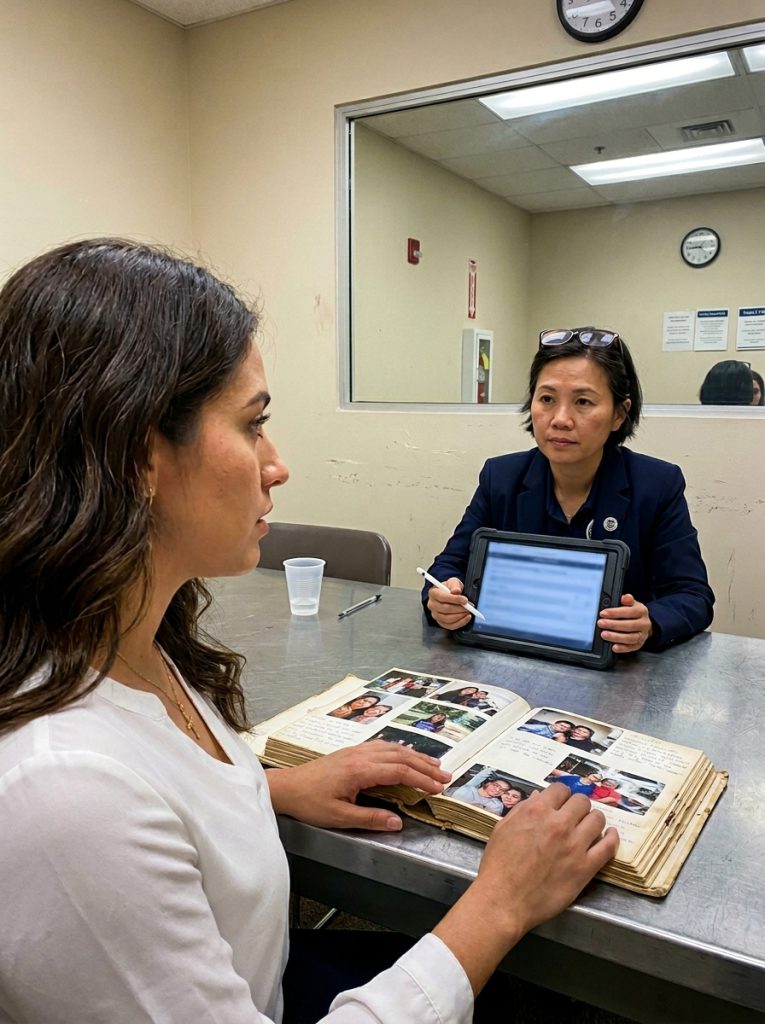
The hallway outside the interview room was where everything ended for Victor.
I didn’t see it happen. I was still inside with Officer Tran, looking at the tablet screen, looking at the other woman’s name — Maria Catalina Flores — and the petition dated eighteen months before Victor ever walked into my cousin’s birthday party and told me I was the most beautiful woman he’d ever seen.
He’d said those exact words before. To her. In a different office. In a different city.
Officer Tran let me sit with it.
She didn’t push. She didn’t ask “did you know?” because she could see on my face that I didn’t. She could see that the woman sitting across from her with a photo album full of real memories and a gold cross at her throat had loved this man genuinely, stupidly, completely.
“Daniela,” she said after a while. “I need you to understand something.”
I looked up.
“You are not in trouble.”
My eyes burned.
“The evidence we have — his prior petition, the inconsistencies in his answers today, and a financial trail we’ve been following for six months — all of it points to Victor Saldana operating a marriage fraud scheme through a third-party agency. You are not the first woman he’s done this to. Maria Catalina Flores was the first. You are the second.”
I pressed my fingers against the album cover.
“There may be a third,” she added. “We’re still looking.”
A third.
I thought about the nights he came home late. The phone calls in Spanish that he took in the garage. The way he’d sometimes call me “mija” and sometimes seem to forget my middle name.
I thought about the taco truck on Westheimer. The photo of us at Galveston. The selfie at the apartment.
Had any of it been real?
“The love was real,” I said. Out loud. Without meaning to.
Officer Tran looked at me.
“For me,” I clarified. “The love was real for me.”
She nodded slowly. “I believe that.”
Then she told me what was happening in the hallway.
Victor had been escorted from his interview room by two plainclothes agents. His ill-fitting dress shirt was untucked at the back. His cufflink — the one he always fidgeted with — had come loose and was in his pocket. His slicked-back hair had separated at the temples from sweat.
They’d confronted him with the inconsistencies. He’d tried to laugh them off at first. Then he’d tried to explain. Then he’d asked for a lawyer.
That’s when they’d shown him Maria Catalina Flores’s photo.
And Victor had gone quiet.
Not the quiet of an innocent man protecting himself. The quiet of a man who knows it’s over.
They arrested him in the hallway. Handcuffs. The whole thing. Right there in the USCIS field office where I had walked in that morning holding a photo album and believing that today would be the day my life got better.
Officer Tran walked me to the lobby.
“What happens to me?” I asked.
She stopped walking. She turned to face me fully. Reading glasses still pushed up on her forehead. Tablet pen clipped to her blazer pocket.
“You have options,” she said. “As a victim of marriage fraud, you qualify for protections under the Violence Against Women Act. Your immigration case will be reviewed independently. You don’t need Victor for this. You never did.”
I stood there in that lobby — beige walls, plastic chairs, a water cooler humming in the corner — and I felt something I hadn’t expected.
Relief.
Not happiness. Not victory. But the specific relief of someone who has been carrying a weight they didn’t know was there until someone named it.
Victor had married me because an agency told him I was safe. Because I was already in love. Because I wouldn’t question the gaps.
But I had questioned them. In small ways. In the middle of the night when he was asleep and I was staring at the ceiling. I’d questioned them and then buried the questions because I was afraid that asking would make it all collapse.
It had collapsed anyway.
And somehow — standing in that fluorescent lobby with my photo album under my arm and my gold cross warm against my throat — I felt more solid than I had in two years.
I walked out of the building into Houston heat. Ten in the morning and already ninety degrees. The parking lot shimmered.
My cousin was waiting in her car. She’d driven me. She took one look at my face and said nothing. Just reached across and opened the passenger door.
I got in.
I held the album on my lap.
“He’s gone,” I said.
She nodded.
“And I’m staying.”
She reached over and squeezed my hand.
We drove to her apartment. She made me coffee. I sat at her kitchen table and opened the album one more time.
I looked at every photo.
The taco truck. Galveston. The quinceañera. The apartment selfie.
In every one, I was smiling. In every one, my eyes were full of something I can only call hope.
That hope wasn’t fake. It wasn’t performed. It wasn’t part of anyone’s scheme.
It was mine.
And I decided, sitting there at my cousin’s kitchen table with instant coffee going cold in my hands, that I would not let Victor Saldana’s lies make my love a thing to be ashamed of.
I loved honestly. I showed up honestly. I answered every question in that interview room with the truth.
The truth protected me.
It didn’t protect him.
Three months later, I received a letter from USCIS. My case had been adjudicated independently. My status was approved.
I framed the letter. I hung it in my apartment — a studio in Montrose with a tiny balcony and a view of a parking lot that somehow felt like freedom.
Victor was convicted on two counts of immigration fraud. I don’t know where he is now. I don’t look him up.
The photo album is in my closet. I don’t throw it away. Those memories were real — at least my side of them. And I refuse to erase the parts of my story that prove I was capable of love.
Advertisement
The legal process took eight months total. There were depositions. There were hearings. There were moments where I sat in plastic chairs in government buildings and answered the same questions over and over.
But each time, I answered the same way. With the truth. With the details. With the pet name and the toothbrush color and the side of the bed.
Because those things were real.
Officer Tran sent me a note after the conviction. Handwritten on a plain notecard. It said: “Your honesty made this case. Thank you for being brave in that room.”
I keep it in my nightstand drawer.
Some nights I open it and read it again. Not because I need validation. But because there was a version of this story where I never walked into that interview room at all. Where Victor convinced me to skip the appointment. Where the petition lapsed and he moved on to the next woman and I spent years wondering why my husband seemed to forget my middle name.
In that version, I’m still waiting for someone to see me.
In this version — my version — I walked into a beige room with fluorescent lights and a metal table and I laid my entire heart on that table in the form of a photo album.
And the truth did the rest.
My cousin says I’m braver than I think.
I don’t know about brave. I think I was just honest. And sometimes honesty is the hardest kind of courage there is.
Even when the love wasn’t returned.
Even when it was used.
Especially then.