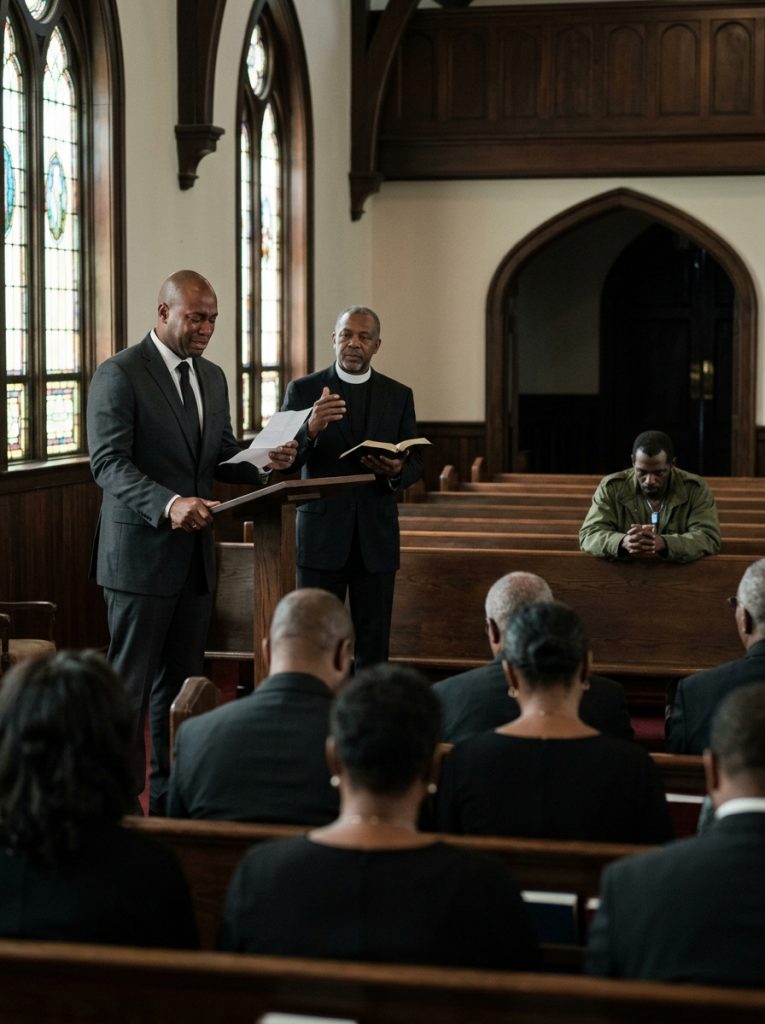
My mother’s scream was the worst sound I have ever heard in my life.
It wasn’t loud. That’s the thing people don’t understand about grief colliding with shock. It wasn’t a movie scream. It was a small, broken noise — like someone stepping on a bird. A sound that came from a place in her body that had been sealed shut for seven weeks.
She turned in the front pew. Her hand went to her mouth. Her knees buckled but my aunt caught her.
And Elijah — my brother, the dead man, the alive man — froze in the aisle.
“Mama,” he said.
His voice was hoarse. Like he hadn’t used it in weeks. Like the word itself cost him something.
The congregation erupted. Not in anger — not yet. In confusion. People standing. People looking from the casket (empty, I would learn later) to the man in the olive army jacket. Pastor Williams dropped his Bible. It hit the pulpit with a sound like a gavel.
I gripped the lectern.
My legs wouldn’t move.
“Eli,” I said.
He looked at me. Those same brown eyes. Deeper now. Hollowed. But the same.
“I’m sorry, Marcus,” he whispered.
Sorry.
Four years of lies and he said sorry like it was a parking ticket.
I came down from the lectern. Three steps. Four. My charcoal suit felt like it weighed two hundred pounds. I walked straight to him and I did something I didn’t plan: I grabbed him. Both arms. Pulled him in. Held him so tight that his dog tag pressed into my collarbone through his jacket.
He was real.
He was solid.
He was alive.
And I hated him for it.
I pushed him back. Held his shoulders.
“Where,” I said. “Where have you been.”
Not a question. A demand.
The chapel was chaos now. My mother was trying to stand. My aunt was crying. Cousins were shouting. Pastor Williams was saying something about God’s plan but nobody was listening.
Elijah looked at the floor.
“Can we go somewhere?”
I wanted to scream. I wanted to hit him. I wanted to hold him again.
“Outside,” I said. “Now.”
We walked through the entrance archway into the parking lot. Overcast sky. The air was thick and warm, the way Charleston gets in the summer. Spanish moss hanging from the oaks. My rental sedan parked beside my mother’s Buick.
I leaned against the hood.
“Talk,” I said.
Elijah stood three feet away. Hands in his jacket pockets. Dog tag chain catching what little light came through the clouds.
“There was no deployment,” he said.
I already knew that. I’d known it since the moment I saw him breathing.
“I was in debt. Bad debt. Not credit cards, Marcus. Not student loans. I owed people — people who don’t send letters. They came to the house. They sat in Mama’s living room and told me what they’d do to her if I didn’t pay.”
My fists clenched.
“So I disappeared,” he said. “I found a guy who could fake military papers. Told the family I’d been called up. Reserves. Classified. It bought me time. I went to Atlanta. Worked construction under a different name. Sent money back through a shell account to cover the payments.”
“And the death?” I said.
He swallowed.
“They found me. In Atlanta. Six months ago. I had to die on paper or they’d come back to Charleston. Come back to Mama. So I called in a favor — a guy who knew a guy at the VA. Falsified a casualty report. Sent the flag and the tag.”
“That tag was real,” I said. “Mama sleeps with it.”
His face crumpled.
“I know.”
Silence.
A car passed on the street. Normal people going to normal Saturday things.
“You let us grieve,” I said. “You let me write a eulogy. You let Mama collapse on her kitchen floor. You let her age ten years in seven weeks.”
“I thought it was the only way to keep you safe.”
“From who?”
He told me the name. I won’t write it here. But it was enough to make my stomach drop because I’d heard it before — in news stories, in whispered warnings at the barbershop, in the kind of conversations that stop when someone walks in.
“Are we safe now?” I asked.
Elijah pulled a folded piece of paper from his jacket. A receipt. A final payment confirmation from a third-party escrow service.
“Paid in full,” he said. “As of last Monday. It’s done.”
I looked at the receipt.
I looked at him.
“Then why are you here?” I said. “If it’s over, why come to your own funeral? Why not just call?”
He pulled the tag over his head. Held it in his palm.
“Because I needed to see her face,” he said. “I needed to know if she’d forgive me. And I needed to hear what you said about me at that lectern — because I don’t deserve any of it, Marcus. I know that. But I needed to hear it anyway.”
I stared at him for a long time.
Then I said the thing that cracked us both open.
“The restaurant is gone, Eli.”
His face changed.
Advertisement
“What?”
“Mama’s restaurant. The one you said the debt was protecting. The creditors seized it two days ago. Some kind of secondary claim — tied to the original debt, a clause you didn’t read. They took it Tuesday. We found out Wednesday. The funeral was already planned.”
Elijah’s knees gave out.
He sat down on the parking lot asphalt in his army jacket and put his hands over his face.
The restaurant. The one our grandmother opened in 1974. The one that employed half our block. The one that was supposed to be the reason for all of this.
Gone.
Before he could even walk back through the door.
I sat down beside him. The asphalt was hot through my suit pants.
“You saved us,” I said. “But you were too late for the thing that mattered most.”
He didn’t speak for a long time.
Then he said: “Does Mama know? About the restaurant?”
“She knows. She signed the papers yesterday. She thought she was signing them for your funeral expenses.”
He made a sound like someone had reached into his chest and pulled something out.
I put my hand on his shoulder.
And we sat there — two brothers in a parking lot outside a funeral chapel, one alive and one grieving for something that couldn’t be brought back — until my mother appeared in the archway.
She walked across the lot in her black dress and her low heels.
She stood in front of Elijah.
She slapped him.
Then she pulled him up off the ground and held him like he was five years old and she’d found him after a thunderstorm.
“Don’t you ever,” she whispered. “Don’t you ever leave me again.”
He nodded into her shoulder.
And I stood there in my charcoal suit, tear tracks dry on my face, holding a eulogy I’d never need again — knowing that my brother was alive, that the debt was paid, and that the restaurant was still gone.
We went back inside eventually. Not to the chapel — to the fellowship hall behind it, where the reception food was already laid out. Ham sandwiches and sweet tea for a wake that no longer made sense.
My aunt took charge. She told people what she thought they needed to hear: Elijah had been in protective custody. A government situation. It was classified. She said it with enough authority that most people nodded and moved on.
But my mother didn’t move on.
She sat in a plastic chair with Elijah’s hand in hers and she didn’t let go for two hours. Not when people brought her tea. Not when the pastor came to pray. Not when I told her we should go home.
“Not yet,” she said. “I need to feel him breathe a little longer.”
Elijah told her about the restaurant that night. In her kitchen. At the table where she’d taught us both to peel shrimp.
She didn’t scream. She didn’t cry.
She said: “I signed those papers thinking it was the last thing I could do for you. Now you’re here. And that’s worth more than any building.”
Elijah cried.
I cried.
She made us grits at midnight and we ate them standing up because nobody wanted to sit in a chair that felt too permanent.
Some things you save too late.
But some people — if you’re lucky — come back just in time to hear how much they were loved.