The Suitcase My Neighbor Left Behind Revealed Why He Chose Me
PART 3 (FULL STORY)
The lawyer’s answer stayed between us for several seconds.
I looked down at the suitcase again.
The photograph was still in my hand, the edges soft from years of being handled.
Arthur was standing beside my mother in the picture, but they did not look like two people who had simply known each other.
They looked comfortable.
Close.
Familiar.
My mother was smiling in a way I had not seen in years.
“What did he know?” I asked again.
The lawyer stepped inside after I moved away from the door.
His name was Martin Hale, and I remembered seeing him at the funeral standing several rows behind Arthur’s family.
He closed the door quietly and glanced toward the kitchen table.
“Arthur told me that if you opened the suitcase, you would have questions.”
“I have more than questions.”
“I know.”
I placed the photograph beside the envelopes.
“Start with my mother.”
Martin pulled out the chair across from me but did not sit until I did.
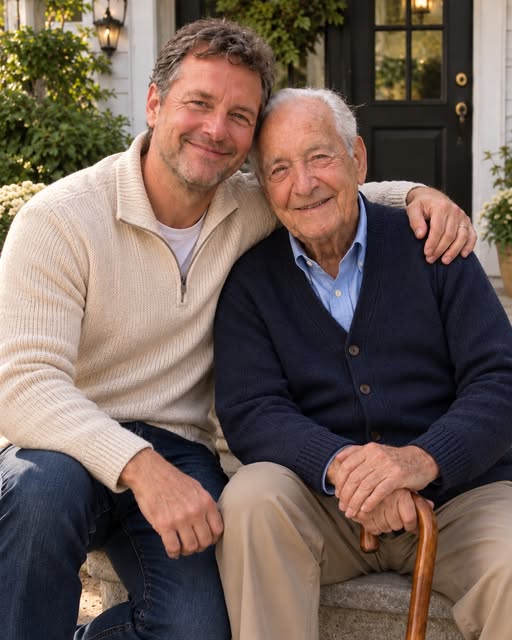
“Arthur was your grandfather, Julian.”
I stared at him.
For a moment, the sentence did not make sense.
Arthur Sterling was my neighbor.
He was the old man who complained about the weather, saved the Sunday newspaper until Monday, and always bought the same brand of coffee.
He was the man I had carried groceries for.
He was not my grandfather.
“My grandfather died when I was nine,” I said.
“Your mother told you that.”
“Yes.”
“She told you his name was Thomas?”
I nodded.
Martin looked at the photograph.
“Thomas was your mother’s husband.”
I felt the air leave the room.
“My father?”
“No.”
I looked at him.
“Then who was he?”
Martin did not answer immediately.
Instead, he pointed toward the three envelopes.
“Read those first.”
The first envelope was dated thirty-seven years earlier.
The name on the front was Elena Sterling.
My mother had not used the surname Sterling after she married Thomas.
I opened it carefully.
Inside was a single page written in Arthur’s handwriting.
Elena,
I know you do not want to hear from me, but I am asking you for one chance to explain.
I did not leave because I stopped loving you.
I left because your father gave me an ultimatum I could not live with.
I want to know whether the baby is mine.
The page ended there.
No signature was necessary.
I knew the handwriting.
Arthur.
I looked at Martin.
“My mother was pregnant.”
“Yes.”
“With me.”
“Yes.”
“And Arthur knew?”
“He knew there was a possibility.”
“Possibility?”
Martin folded his hands.
“Your mother left town before Arthur could find out for certain.”
I stared at the old photograph again.
Everything I knew about my childhood suddenly felt incomplete.
My mother had raised me alone after Thomas died.
She rarely talked about the years before my birth.
Whenever I asked about my biological father, she would say only that some things were better left in the past.
I had accepted that answer because I had no reason not to.
Until now.
“Why didn’t Arthur tell me?”
“That question is answered in the second envelope.”
My fingers felt numb as I opened it.
This letter was shorter.
Elena,
I found him.
He is living two streets from me.
He looks like you.
I don’t know whether I have the right to approach him.
I will not force myself into his life.
If he ever needs me, I will be here.
Arthur
There was no date.
I looked up.
“He knew where I lived?”
Martin nodded.
“He knew before you moved into the house next door.”
I stood so quickly the chair scraped the floor.
“What?”
“He knew who you were when you bought the house.”
I remembered the first day I had moved in.
Arthur had been standing on his porch.
He had watched the moving truck arrive.
I had assumed he was simply curious about the new neighbor.
Now I remembered something I had forgotten.
He had looked at me for a long time before saying hello.
At the time, I thought it was because he was hard of hearing.
It wasn’t.
He had recognized me.
“Why didn’t he tell me?”
“Because your mother asked him not to.”
That answer hurt more than I expected.
My mother had been dead for six years.
There was no one left to ask why.
I opened the third envelope.
Inside was a letter from my mother.
My hands started shaking before I even read the first line.
Dad,
If you are reading this, then Julian has probably found out who you are.
I stopped.
I had to put the letter down.
Martin looked away.
I picked it up again.
I know you think I kept him from you because I was angry.
That isn’t the whole truth.
I was afraid.
You wanted to tell Julian everything when he was young, but I couldn’t bear the thought of him growing up wondering why his father had never stayed.
I had already lost one family.
I didn’t want him carrying another absence.
Thomas agreed to raise him as his own, and he did.
He loved Julian.
So did I.
Please don’t make Julian choose between the people who raised him and the man who gave him his blood.
If you ever find him, just be there.
Do not ask him to call you Dad.
Do not ask him to forgive you for a life he never knew you were part of.
Just be there.
I lowered the letter.
For twelve years, Arthur had done exactly that.
He had been there.
He had waited by his door every Sunday.
He had listened to me complain about work.
He had remembered the name of my first serious girlfriend.
He had asked about my mother every year on the anniversary of her death, even though I had never understood why.
And every Sunday, when I carried his groceries into his kitchen, he had looked at me with the expression of someone who knew something I didn’t.
I thought about all the times he had tried to pay me.
Maybe the money had never been about groceries.
Maybe it had been his way of testing whether he could give me something without telling me why.
“Did he ever tell my mother he had found me?”
“No.”
“Did she know I lived here?”
Martin nodded.
“She knew.”
I sat down again.
“My mother knew Arthur lived next door?”
“Yes.”
“And she never told me?”
“She believed she was protecting you.”
I looked at the suitcase.
There were still things inside.
A small wooden box.
A stack of photographs.
A folded map.
A receipt from a hospital.
And several grocery lists.
I picked up the grocery lists.
They were mine.
Not my handwriting.
Arthur’s.
The first one was from the year I moved in.
Milk.
Bread.
Coffee.
Eggs.
Apples.
Beside the list was a note.
He likes these.
I swallowed.
The next list had another note.
No tomatoes.
He always leaves them behind.
Another read:
Buy the cereal he mentioned.
He looked happy when he talked about it.
I laughed once, but the sound came out broken.
For twelve years, I had thought I was taking care of Arthur.
He had been paying attention to me too.
Not financially.
Not because he needed something from me.
Because I was his grandson.
I opened the wooden box.
Inside was a small silver watch.
I recognized it immediately.
It had belonged to my mother.
I had seen it once when I was a child.
I remembered her wearing it on Sundays.
After she died, I thought it had disappeared.
There was a folded note beneath it.
For Julian.
I opened it.
My dear boy,
If you are reading this, then I finally ran out of time.
I spent twelve years beside you and never found the courage to tell you who I was.
That is the truth I regret most.
Not because I was ashamed of being your grandfather.
Because I was afraid that knowing would change the kindness between us.
You helped me when you thought I was simply an old man who needed groceries.
That mattered to me more than anything money could have bought.
If you had known who I was, I worried every Sunday would become an obligation.
I wanted one thing in my last years that I had never been able to have.
A relationship with you that you chose.
You chose it.
Every Sunday.
No one forced you.
No one paid you.
You simply showed up.
That was enough for me.
There was one more thing I needed you to know.
I did not leave you only memories.
I looked at Martin.
“What does that mean?”
He nodded toward the folded map.
“Open it.”
I unfolded it across the table.
It was a map of the neighborhood.
Arthur’s house was marked in blue.
My house was marked in red.
Between them was a small line drawn by hand.
At the end of the line was a property number.
I recognized it.
It was the address of the vacant house three doors down.
“The house has been empty for years,” I said.
“Arthur bought it.”
I looked at Martin.
“When?”
“Eight years ago.”
“Why?”
“He wanted to create something for the neighborhood.”
Martin took a document from the suitcase.
It was a copy of a trust agreement.
Arthur had placed the vacant property into a small community trust.
The plan was to turn it into a food pantry and community kitchen.
The grocery trips had given him the idea.
He had seen how many older people in the neighborhood struggled to get food.
He had noticed how often people were too embarrassed to ask for help.
He wanted a place where no one had to explain why they needed groceries.
“He left this to the neighborhood?” I asked.
“Not exactly.”
Martin pointed to the final page.
“He left the trust to you.”
I stared at the document.
“There has to be a mistake.”
“There isn’t.”
I read the clause twice.
Arthur had named me trustee.
Not owner.
Not beneficiary.
Trustee.
He had left me responsibility, not wealth.
The property could not be sold for personal profit.
It had to be used for the purpose he had written down.
I looked at Martin.
“Why would he do that?”
“Because he knew you would understand why.”
I thought about the first Sunday.
The grocery bags.
His unsteady knees.
The coffee.
The sentence I had spoken without thinking.
Next time you need groceries, just call me.
Maybe that was when everything had started.
Not the secret.
The trust.
Arthur had spent twelve years watching what I did when nobody was rewarding me for it.
And when he died, he trusted me with something bigger.
I spent the next several weeks going through his papers.
There were no hidden millions.
No secret accounts.
No dramatic inheritance.
There were receipts from grocery stores, notes about neighbors, old photographs, letters he had never sent, and a folder containing names of people who needed help.
Some were widows.
Some were elderly men.
One was a single mother who lived at the end of our street.
Arthur had been quietly helping them too.
Not enough to make them dependent.
Just enough to get them through difficult weeks.
I understood then why he had always hated being thanked.
He never wanted gratitude.
He wanted dignity.
Three months after the funeral, the old vacant house reopened.
We painted the walls.
We repaired the kitchen.
Neighbors donated shelves and refrigerators.
A local contractor volunteered labor after learning what Arthur had planned.
I put a small wooden sign above the door.
Sterling Community Pantry.
I considered changing the name.
Then I didn’t.
Arthur had spent his life avoiding attention.
For once, I thought he deserved his name on something.
On the first Sunday we opened, I stood behind the counter before anyone arrived.
For a moment, I expected to hear the familiar sound of Arthur’s front door opening.
I almost turned toward his house.
Then I remembered.
There would be no coffee waiting next door.
No grocery list folded on his kitchen counter.
No voice telling me that I had bought the wrong bread again.
But there was something else.
A woman came through the door carrying a small child.
She looked embarrassed.
“I don’t know if I’m supposed to be here,” she said.
I smiled.
“You are.”
She looked at the shelves.
“Do I have to pay?”
“No.”
She hesitated.
“Are you sure?”
I thought of Arthur.
“I’m sure.”
She thanked me and began choosing groceries.
I watched her child pick up an apple with both hands.
For the first time since Arthur’s funeral, I felt something other than loss.
Not happiness exactly.
Something quieter.
Continuity.
That evening, I went home and opened the suitcase one last time.
At the bottom was a final grocery list.
Milk.
Bread.
Coffee.
Apples.
And underneath it, in Arthur’s handwriting:
For Julian.
I sat at my kitchen table for a long time.
Then I folded the list carefully and placed it beside the silver watch.
The next morning, I hung the watch above my desk.
I still buy groceries on Sundays.
I just don’t take them next door anymore.
I take them across the street, to the pantry Arthur left behind.
And every Sunday morning, before I unlock the door, I look at the old silver watch and think about the man who spent twelve years letting me believe I was the one taking care of him.
Then I turn the key.
The lock clicks.
The door opens.
And the first thing I do is put the milk in the refrigerator, exactly where Arthur taught me to put it.