The Stranger I Met on My 62nd Birthday Left a Letter That Changed My Family
PART 3 (FULL STORY)
I pressed the phone so tightly against my ear that my fingers began to ache.
“Mom?” my daughter, Laura, said. “What’s wrong? You sound strange.”
I stared at the photograph on the bed. Daniel stood in the middle of it, wearing the same easy smile I’d seen across the bar the night before. Beside him was Laura’s husband, Mark. They were standing outside a building I didn’t recognize, their arms around each other’s shoulders as if they had known each other for years.
“Laura, I need you to answer something honestly,” I said. “Do you know a man named Daniel?”
She didn’t answer immediately.
That pause frightened me more than anything she could have said.
“Why are you asking about him?”
“Because I met him last night. And this morning, he left me a letter with a photograph of him and Mark.”
The silence on the other end lasted so long that I checked to make sure the call hadn’t disconnected.
Then Laura whispered, “Mom, where are you?”
I told her the name of the hotel.
“Stay there,” she said. “Don’t throw anything away. I’m coming.”
“Laura, what is going on?”
“I’ll explain when I get there.”
She ended the call before I could ask another question.
I lowered the phone and looked at the letter again. I had read only the first few lines before calling her, and now I forced myself to continue.
The letter began with an apology.
Daniel wrote that he knew I would probably hate him after reading it, but he hoped I would at least understand why he had approached me. He said he hadn’t intended to hurt me. He had recognized my surname when I introduced myself the night before, and that recognition had changed his decision to speak to me.
He had known Mark for several years.
They had once worked together on a photography project, and Daniel had been present during a period of Mark’s life that my daughter knew almost nothing about.
According to the letter, Daniel had not approached me to steal money, expose a secret, or embarrass me. He had approached me because he had wanted to tell me something about my son-in-law.
But he had lost his nerve.
The rest of the letter was vague. Daniel wrote that he had left the photograph because he believed I deserved to know the truth, but he couldn’t bring himself to explain it face-to-face.
I read the final sentence twice.
Ask Mark why he stopped speaking to his older brother.
I sat completely still.
Mark had an older brother?
Laura had been married to him for twelve years. I had attended their wedding, celebrated birthdays with his family, and spent holidays at their home. I knew about his parents and his younger sister. I had heard stories about his childhood and his first job.
Not once had I heard him mention an older brother.
I turned the photograph over.
On the back, Daniel had written a date and an address.
The date was almost eight years old.
The address was for a hospital.
Before I could make sense of it, someone knocked on the hotel door.
Laura arrived twenty minutes later, still wearing the clothes she’d apparently thrown on in a hurry. Her hair was tied back carelessly, and she was holding her car keys in one hand.
She looked at the envelope on the bed before she looked at me.
“You slept with him?” she asked.
Her voice wasn’t loud, but the question landed between us like a glass breaking on the floor.
I felt my face grow hot.
“Yes,” I said. “I did. I know how that sounds.”
She closed her eyes for a moment.
“I’m not here to judge you, Mom.”
“Then tell me why a man I met last night knows your husband.”
Laura sat in the chair by the window. For a few seconds, she rubbed her forehead as if she were trying to decide where to begin.
“Mark did have an older brother,” she said. “His name was Andrew.”
“Had?”
“He died eight years ago.”
I looked down at the date on the photograph.
“What happened to him?”
Laura took a slow breath.
“That’s what Mark never talks about.”
She explained that she had met Mark shortly after Andrew’s death. At the time, Mark told her that his brother had struggled with money and personal problems. They had argued over a family business, and Andrew had eventually left town. A few months later, Mark received a call telling him that Andrew had been admitted to a hospital after an accident.
Mark went to see him.
Andrew died the following day.
Mark rarely discussed the experience, and Laura had assumed it was because the loss was too painful. She had never pushed him to tell her more.
“But what does Daniel have to do with any of this?” I asked.
Laura picked up the photograph.
“I don’t know. Mark told me he used to work with a photographer named Daniel, but he said they lost touch.”
She turned the picture over and stared at the address.
“Mom, this hospital is where Andrew died.”
The room seemed smaller suddenly.
“Did Mark know Daniel would be at the bar?”
“I have no idea.”
“Did Daniel know who I was before he approached me?”
Laura nodded toward the letter.
“He says he recognized your surname.”
I looked at her.
“Then why didn’t he simply tell me what he wanted?”
“Maybe he thought you’d refuse to listen. Maybe he wanted to find out whether you’d tell Mark about meeting him. I don’t know.”
I couldn’t blame her for not having answers. She looked as confused as I felt.
Still, one thought kept returning.
Daniel had spent hours listening to me talk about my family. He had celebrated my birthday with a candle and dessert. He had made me feel less invisible at a time when I had desperately needed kindness.
Had any of that been genuine?
Or had I simply been a convenient way to reach someone he could not confront directly?
“I need to speak to Mark,” I said.
Laura nodded, but she didn’t reach for her phone.
“There’s something else you should know.”
I waited.
“Mark and I argued about Andrew last week. I asked him why he never talked about his brother. He told me it was none of my business.”
“That seems rather harsh.”
“He said there were things about Andrew that I would never understand.”
She looked down at the photograph again.
“Then yesterday, I found him searching through an old box of papers. When I asked what he was doing, he said he was looking for a receipt.”
“What kind of receipt?”
“He wouldn’t tell me.”
For the first time that morning, Laura looked frightened.
I took the letter from her and placed it back inside the envelope. Whatever Daniel had intended, I couldn’t allow the mystery to grow through guesses and half-remembered conversations.
“We’re going to ask Mark,” I said.
Laura looked at me with surprise.
“Together?”
“Of course. He’s your husband, but he’s also part of this family. If something happened to his brother that he has hidden from you for twelve years, we deserve an explanation.”
We left the hotel shortly afterward.
On the drive to Laura’s house, I kept the envelope in my handbag. The city passed outside the window, full of people going about their ordinary Saturday mornings. A woman carried flowers across a crosswalk. Two men argued over a parking space. A young couple laughed as they hurried into a café.
It seemed impossible that the previous night had begun with something as simple as a birthday nobody remembered.
I had gone out hoping to feel less alone.
Now I was carrying a photograph that threatened to expose a part of my daughter’s marriage she had never known existed.
When we arrived, Mark was in the kitchen making coffee.
He glanced up and smiled at Laura.
Then he saw me.
“Your mother?” he asked. “What happened?”
Laura placed the photograph on the counter.
Mark’s smile disappeared.
For several seconds, he didn’t move.
Then he picked up the photograph and turned it over.
“Where did you get this?”
“From Daniel,” I said.
His eyes lifted to mine.
“You met Daniel?”
“Yes. Last night.”
Mark put the photograph down so carefully that it seemed he was afraid it might break.
“Did he tell you anything?”
“He left a letter. He said I should ask you why you stopped speaking to your older brother.”
Mark’s face changed.
Not dramatically. He didn’t shout or storm out. He simply looked away, set his coffee cup down, and rubbed the bridge of his nose.
“Daniel has no right to involve your mother in this,” he said.
“Then explain it to me,” Laura replied.
“It’s complicated.”
“You’ve had twelve years to explain it.”
Mark looked at his wife.
“I was trying to protect you.”
“From what?”
He didn’t answer.
I sat at the kitchen table, feeling suddenly exhausted. I had spent the morning imagining all kinds of terrible possibilities. Perhaps Mark had stolen from his brother. Perhaps he had abandoned him during a crisis. Perhaps the photograph revealed a secret relationship or some other betrayal.
But the truth, whatever it was, had to come from him.
“Mark,” I said quietly, “I don’t know what happened between you and Andrew. I don’t know why Daniel came looking for me. But I do know what it feels like to lose someone and be left with questions you can’t ask anymore.”
He looked at me.
“When my husband died, I spent months wishing I had asked him things I thought I had all the time in the world to ask. Don’t make the same mistake with your wife.”
Mark pulled out a chair and sat down.
For a long moment, he stared at the wood grain of the table.
Then he began to speak.
Andrew had been four years older than him. When their father died, the two brothers inherited a small photography studio that had been in the family for decades. Andrew was the talented one, Mark said. He could make ordinary people look extraordinary in a photograph. Mark handled the business side, managed appointments, and kept track of the bills.
For a while, they worked well together.
Then the studio began losing money.
Andrew wanted to expand into wedding photography and invest in new equipment. Mark wanted to cut expenses and keep the business small. Their arguments became more frequent, and eventually Mark accused Andrew of spending money without permission.
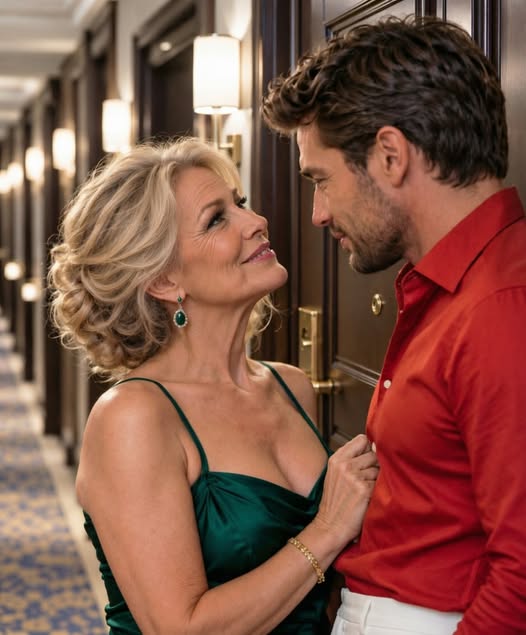
Andrew denied it.
They argued one evening in the studio. Mark said things he regretted, including that Andrew was irresponsible and would ruin everything their father had built.
Andrew walked out.
They didn’t speak for several weeks.
Then Andrew was involved in a car accident while traveling to another town for a photography assignment.
He was taken to the hospital listed on the back of the photograph.
Mark received the call and went there immediately.
Andrew was conscious when Mark arrived, but he was badly injured. The doctors warned that his condition could deteriorate quickly.
“Did you speak to him?” Laura asked.
“Yes.”
“Did you make peace?”
Mark looked down.
“I tried.”
He told us that Andrew had asked about the studio. Mark assured him that everything would be all right. Then Andrew asked him to bring a small box from the studio, one he had kept locked in a cabinet.
Mark said he would.
But before he could leave the hospital, Andrew’s condition worsened. He died the next morning.
Mark never brought the box.
“I couldn’t go back into the studio after the funeral,” he said. “Everything reminded me of him. I sold my share of the business and moved on.”
Laura’s expression softened, but she didn’t reach for his hand.
“What was in the box?”
Mark shook his head.
“I don’t know.”
“Then how could you know it wasn’t important?”
“I didn’t say it wasn’t important.”
“You avoided it for eight years. You never told me he asked you for it. You never told me you had a brother you hadn’t spoken to when he died.”
Mark flinched at the words.
“I was ashamed,” he said. “I thought we’d have more time. I thought I could call him after the argument, apologize, and everything would go back to normal. Then the accident happened, and I couldn’t change anything.”
His voice grew quieter.
“After that, every time someone asked about Andrew, I told them we hadn’t been close. It was easier than admitting that the last real conversation we’d had was an argument.”
I understood that kind of regret.
Grief often leaves people clinging to the version of the story they can bear to tell. Sometimes they hide the truth because it hurts. Sometimes they hide it because they are afraid someone will judge them for the things they did when they still had a chance to do better.
But there was still one unanswered question.
“Why did Daniel come looking for me?” I asked.
Mark looked toward the window.
“Because he found something.”
“What?”
“About Andrew. About the studio.”
Laura leaned forward.
“Mark, stop giving us pieces of the story. What did Daniel find?”
Mark swallowed.
“Last month, Daniel contacted me. He said he had been sorting through old photographs and papers from the studio. He found a folder that belonged to Andrew, and there were things in it that made him think I had misunderstood what happened before the accident.”
“What things?”
“I told him I didn’t want to discuss it.”
“Why?”
“Because I couldn’t face it.”
Laura shook her head.
“And when he wouldn’t leave it alone, you ignored him?”
“Yes.”
Mark looked at me.
“I never imagined he’d approach you.”
“Neither did I,” I said.
The words came out more sharply than I intended.
Mark lowered his eyes.
I thought of Daniel across the table in the bar, listening to me describe my husband’s death and my children’s busy lives. He had known something about my family, yet he had let me believe that we were simply two strangers sharing an unexpected conversation.
I wasn’t sure whether I felt angry with him or grateful that he had finally forced the truth into the open.
“Do you have the folder?” I asked.
Mark hesitated.
Then he stood and walked to the small office at the back of the house.
When he returned, he was carrying an old cardboard box.
He placed it on the kitchen table and opened the lid.
Inside were several envelopes, a stack of photographs, a few account books, and a small brass key.
Mark stared at the key.
“I thought I’d lost this.”
Laura picked up one of the envelopes. Andrew’s handwriting was visible across the front.
She didn’t open it.
“Is this the box Andrew wanted you to bring to the hospital?”
Mark nodded.
“I found it after the funeral. I couldn’t make myself open it. I put it away and told myself I’d deal with it later.”
“Eight years later,” Laura said.
“I know.”
I looked at the photographs. Many showed weddings, family gatherings, and ordinary people standing in front of the studio’s backdrop. Andrew had written dates and names on the backs of several.
Then I found one of two young men standing outside the studio.
Andrew was on the left.
Daniel was on the right.
They looked much younger, perhaps in their twenties, and both were smiling.
“Daniel knew Andrew before all this,” I said.
Mark nodded.
“He worked with us for a while. Andrew taught him photography.”
“Then this wasn’t just about you ignoring an old acquaintance.”
“No.”
Mark took the photograph from me.
“Daniel believed Andrew had been treated unfairly. He thought I had blamed my brother for the studio’s financial problems without understanding what had really happened.”
Laura looked at him steadily.
“Did you?”
Mark didn’t answer immediately.
He opened one of the old account books and began turning pages.
At first, the entries looked ordinary: equipment purchases, rent, payments from customers, and expenses. Then he stopped at a page near the middle.
His finger rested on several withdrawals made over a period of months.
“I thought Andrew had taken this money,” he said. “That’s what we fought about.”
“Did he?” I asked.
Mark shook his head slowly.
“I don’t think so.”
He turned the page toward us.
The withdrawals had been authorized using the business account, but the initials beside them were not Andrew’s.
They were Mark’s.
He stared at them as if he had never seen them before.
Then he explained.
During the months before the accident, he had been transferring small amounts from the business account to cover personal expenses. He had intended to replace the money before Andrew noticed. When the business began struggling, he panicked and assumed Andrew had been doing something similar.
Their argument had started because Mark had found a discrepancy in the books and accused Andrew of causing it.
He had never admitted his own withdrawals.
Andrew had denied taking anything, but Mark had refused to believe him.
“I thought he was lying,” Mark said. “I thought he was trying to make me look like the guilty one.”
Laura looked at the account book.
“And then you let him die believing you thought he was a thief.”
Mark covered his face with both hands.
The kitchen was quiet except for the ticking clock above the refrigerator.
I didn’t know what to say. There was no sentence that could give Andrew another day, another conversation, or another chance to hear his brother apologize.
After a while, Mark lowered his hands.
“I didn’t steal a fortune,” he said. “I was careless and frightened, and I kept telling myself I’d fix it. But I accused him of doing the very thing I’d done myself.”
“That doesn’t make it harmless,” Laura said.
“I know.”
“And hiding it from me didn’t protect me. It meant I built my life with someone who couldn’t tell me the truth about his own brother.”
Mark looked at her, pain and shame written plainly across his face.
“I know that, too.”
I reached into my handbag and took out Daniel’s letter.
“There is still something we haven’t answered. Why did he leave this with me instead of confronting you directly?”
Mark read the letter carefully.
When he reached the end, he sat back.
“Daniel told me he wanted to find Andrew’s family photographs and letters before the studio’s old storage unit was cleared out. He thought there might be something in them that could help him understand Andrew’s last months. I refused to help.”
“Why?”
“Because I didn’t want to open that part of my life again.”
He paused.
“Daniel must have realized that I wasn’t going to listen to him. He probably thought you’d be more likely to ask questions if you saw the photograph yourself.”
“That’s a strange way to get someone’s attention,” I said.
“Yes,” Mark replied. “It was.”
I looked at the envelope. Daniel’s apology was there, but it didn’t erase the fact that he had used a very personal encounter to force a family secret into the open.
I had enjoyed the evening with him. That part was true. I had wanted companionship, and for a few hours, I had received it.
But I had also trusted him without knowing why he had approached me.
Both things could be true.
“Did he say anything about the box?” Laura asked.
Mark shook his head.
We searched through the papers for nearly an hour. Most were