The House He Stole From His Wife Was Never Really His To Give Away
PART 3 (FULL STORY)
The name beside Adrian’s signature was my father’s.
I stared at it until the letters blurred.
Richard Hart.
My maiden name.
My father had signed as the authorized trustee of Hartwell Holdings, the family company I had been told was simply a collection of old investments and property my grandfather had left behind.
I had never cared much about it.
That had been exactly what my parents wanted.
My mother sat beside me and folded her hands over her purse.
“Now you understand why we told you to wait until tomorrow.”
“What is this?”
My father answered through the phone.
“The house Adrian transferred to Celeste was never solely his property.”
I swallowed.
“But his name is on the deed.”
“It was,” my father said. “That is not the same thing.”
The administrator cleared his throat.
“I’m sorry, Mrs. Vale, but your father asked us to preserve every document connected to the transfer.”
He placed another paper on the bed.
“This was filed three days before your delivery.”
My hands went cold.
Three days.
Adrian had arranged the transfer while I was still in the hospital waiting for the triplets to arrive.
He had not made a reckless decision after our sons were born.
He had planned it.
My mother opened the envelope beneath my pillow.
Inside were copies of bank statements, property records, corporate filings, and one letter.
I recognized Adrian’s signature before I finished reading the first paragraph.
He had requested a loan against the house.
Then another.
Then another.
My father had refused every request.
So Adrian had done something else.
He had used the property as collateral through a company he secretly controlled.
The house was worth millions.
The debt attached to it was enormous.
And Celeste’s name had been placed on the deed as part of a transfer that Adrian apparently believed would hide the asset from me during the divorce.
I looked at my mother.
“He was going to leave me with the debt.”
“Yes.”
“And give her the house.”
“He thought he was.”
I stared at the documents again.
Something about the wording bothered me.
“What does he mean by ‘authorized trustee’?”
My mother exchanged a glance with my father.
Then she reached for my hand.
“Because the house belonged to your family before it belonged to Adrian.”
I shook my head.
“No.”
“Yes.”
She said it gently.
“Your grandfather built Hartwell Holdings. Your father expanded it. By the time you married Adrian, the company owned more property than you ever knew about.”
I looked at her in disbelief.
“Why didn’t you tell me?”
“Because every time we tried, you said you wanted a normal life.”
That was true.
I had spent years trying to prove I could build a marriage without my parents’ money.
I had never wanted Adrian to know how wealthy my family really was.
My parents had respected that.
They had never put their name on our home.
They had never paid our bills.
They had never interfered.
Until now.
My father spoke again.
“You married him because you loved him.”
I closed my eyes.
“I did.”
“And we accepted that choice.”
His voice hardened.
“But we never agreed to let him destroy you or our grandchildren.”
The hospital administrator quietly collected the documents he had brought.
“There is one more thing.”
I opened my eyes.
“What?”
He placed a smaller envelope on the bed.
“This arrived this morning.”
The return address was Adrian’s attorney.
Inside was a notice demanding that I vacate the house within forty-eight hours.
I almost laughed.
I was still in a hospital bed.
My three sons were barely two days old.
And Adrian wanted me out of my own home.
My mother read the notice and calmly put it down.
“Then we have forty-eight hours.”
“For what?”
“To make sure he never gets another forty-eight minutes.”
That was the first time I saw the woman my father had spent his life loving.
Not the mother who made soup when I was sick.
Not the woman who cried at my wedding.
Not the quiet grandmother who had already memorized the names of all three babies.
She was Richard Hart’s wife.
And Richard Hart was not a man who lost easily.
By noon, three lawyers had arrived.
Not Adrian’s lawyers.
Mine.
The first was a property attorney.
The second specialized in corporate fraud.
The third represented Hartwell Holdings.
They did not speak to me like I was a helpless new mother.
They spoke to me like I was the owner of a legal position that needed to be protected.
That difference mattered.
For the first time since Adrian had walked into my hospital room, I felt the ground beneath me.
Not because I wanted revenge.
Because I finally understood that he had made a mistake much larger than humiliating me.
He had mistaken my silence for weakness.
The lawyers reviewed every page.
The property attorney looked up.
“He forged the timing.”
My father frowned.
“Explain.”
“He filed the transfer before the divorce petition was served, but the supporting declaration says the transfer was made after marital separation.”
She tapped the page.
“That contradiction is going to matter.”
The corporate attorney opened another file.
“And this company?”
I knew the name.
Vale Strategic Ventures.
Adrian had talked about it for years.
He had called it his future.
Apparently, it was his future because he had been quietly moving money into it.
Money from accounts connected to our marriage.
Money I had never seen.
The attorney looked at me.
“Do you recognize these transfers?”
“No.”
“Did you authorize them?”
“No.”
She nodded.
“Then we have a problem for him.”
I looked toward my sleeping sons.
Three tiny faces.
Three tiny fists.
They had been born into a marriage that had collapsed before they could even open their eyes.
I didn’t want them growing up hearing their father described as a monster.
I didn’t want them learning that cruelty was normal.
But I also wasn’t going to let Adrian use them as bargaining chips.
The next morning, he came to the hospital.
This time, he came alone.
He stood in the doorway wearing the same navy suit.
The same expensive watch.
The same expression.
But he looked less certain.
“You’ve made this unnecessarily difficult,” he said.
I was sitting upright now.
My mother was beside me.
Two lawyers were across the room.
Adrian stopped when he saw them.
“What is this?”
My mother smiled.
“Family.”
His eyes moved to my father.
He had not noticed him standing near the window.
Adrian’s face changed.
“Mr. Hart.”
My father nodded.
“Adrian.”
For several seconds, neither spoke.
Then Adrian looked at me.
“You called your father?”
“I called my parents.”
“You don’t need to involve them.”
My mother laughed softly.
“You involved them when you tried to steal their daughter’s home.”
Adrian’s jaw tightened.
“I didn’t steal anything.”
The property attorney slid a document across the table.
“Then you should have no trouble explaining this.”
He picked it up.
His eyes moved across the page.
Then stopped.
“You’re making a mistake.”
My father answered.
“No.”
“You are.”
Adrian looked directly at me.
“Evelyn, listen to me.”
I did.
For the first time in two days, I actually listened without trying to understand how he could have changed.
He hadn’t changed.
I had simply stopped protecting him from the consequences of who he was.
“This can still be private,” he said.
“Private?”
“You, me, the kids.”
He glanced at the lawyers.
“We can settle everything quietly.”
I looked at him.
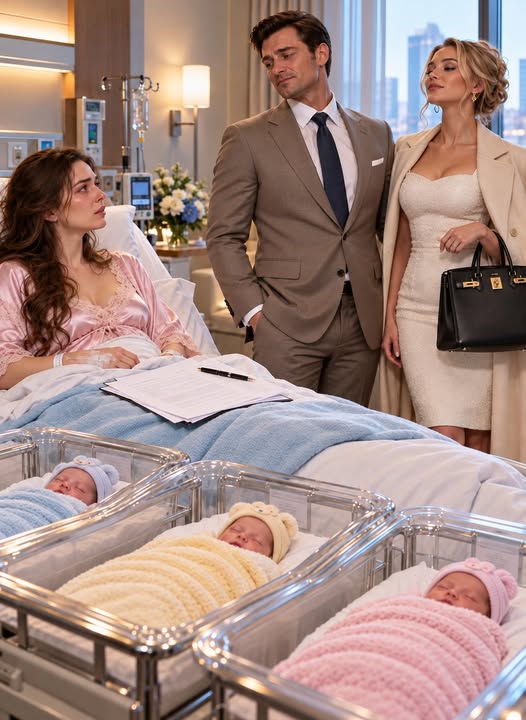
“You brought your mistress into my hospital room.”
His face hardened.
“That was emotional.”
“You called me ugly two days after I gave birth.”
“I was angry.”
“You brought divorce papers while our sons were still in bassinets.”
“I wanted to be honest.”
“And you transferred our home to her.”
He said nothing.
I waited.
Finally, he muttered, “Celeste needed security.”
That sentence told me more than any confession could have.
Not love.
Not guilt.
Not even regret.
Security.
He had chosen to secure another woman’s future with the home where his wife and newborn children were supposed to live.
I nodded slowly.
“Then she can keep the Birkin.”
His eyes narrowed.
“What?”
“The bag.”
I looked at Celeste through the doorway.
She had arrived without my noticing.
She stood there wearing the same confidence she had carried into my hospital room.
But now her confidence looked different.
It looked borrowed.
“You wanted the life,” I said.
“You wanted the house.”
“You wanted the public marriage.”
I looked at Adrian.
“Take it all.”
His expression changed.
Because he knew I wasn’t surrendering.
I was letting go of the things he had used to control me.
The lawyers began explaining the legal consequences.
The transfer would be challenged.
The debt would be investigated.
The corporate accounts would be examined.
The custody agreement he had prepared would not be accepted simply because he had printed it on expensive paper.
And most importantly, the financial records would become part of the divorce proceedings.
Adrian stood there listening.
The first crack appeared when his attorney called.
He stepped into the hallway.
We heard only fragments.
“What do you mean frozen?”
A pause.
“No, that account isn’t supposed to be—”
Another pause.
“Who ordered that?”
He looked back through the doorway.
At my father.
My father said nothing.
He didn’t need to.
The next call came twenty minutes later.
Then another.
Then another.
Celeste’s face slowly lost its confidence.
“What did you do?” she whispered to Adrian.
He didn’t answer.
She touched his arm.
“You said everything was settled.”
He pulled away.
“It was supposed to be.”
That was when I understood something important.
Celeste had believed him.
She had believed the house was his.
She had believed the divorce was already won.
She had believed I was the obstacle.
But she had never asked what he had done to get there.
The Birkin suddenly looked less like a trophy.
It looked like evidence of a promise Adrian could no longer afford to keep.
Three weeks later, the house was under a court order.
Celeste had moved out.
Adrian’s company was being investigated.
The transfers from our marital accounts were traced.
Some money could be recovered.
Some could not.
There was no magical restoration.
No single document returned every dollar he had wasted.
Real consequences were messier than that.
The divorce took months.
The custody arrangement took longer.
I refused to use our sons as weapons.
I asked for what they needed.
Safety.
Stability.
A predictable schedule.
And a father who could not make financial arrangements without accountability.
Adrian fought me at first.
Then the evidence became impossible to ignore.
He eventually accepted a settlement that left him with significantly less than he had expected.
The house returned to my family’s trust.
I could have moved back immediately.
I didn’t.
I sold the house.
Not because Adrian had won.
Because I no longer wanted to wake up in a place where every hallway reminded me of the woman I had been when I trusted him.
My parents helped me find a smaller home near the city.
It had a narrow kitchen, a small garden, and three windows in the nursery.
Nothing about it looked impressive.
I loved it.
One evening, months after the divorce was final, my three sons were asleep upstairs.
I stood in the nursery doorway and watched their chests rise and fall.
My mother had brought me a box from my old house that afternoon.
Most of it was useless.
Wedding photographs.
Old receipts.
A broken watch.
A stack of cards.
At the bottom was the hospital folder Adrian had dropped onto my blanket the day he thought I was powerless.
I opened it.
The divorce papers were still there.
Unsigned.
I ran my fingers across the page.
Once, those papers had looked like the end of my life.
Now they looked like proof of the moment I had finally started living it.
I folded them and placed them back in the box.
Then I noticed something else inside.
A small photograph.
It had been taken the morning after my sons were born.
I was exhausted.
My hair was a mess.
My face was swollen.
I was holding one baby against my chest while my mother held another and my father held the third.
None of us were looking at the camera.
We were looking at each other.
At the time, I had hated that photograph.
I thought I looked terrible.
Now I understood why my father had kept it.
He had wanted me to remember the truth.
I had not looked ugly.
I had looked alive.
I carried the photograph upstairs.
One of my sons stirred as I entered.
I leaned over his crib and adjusted the blanket.
Then I placed the photograph on the dresser beside the three tiny hospital bracelets.
The bracelets were faded now.
The names were still clear.
Three boys.
Three beginnings.
And on the other side of the room, inside a box I no longer needed, were the papers from the man who had told me no one would want me.
I turned off the light.
The nursery went quiet except for the soft hum of the night-light.
Before leaving, I looked back once.
Three small hands rested outside three blankets.
I smiled.
Then I closed the door gently behind me.