She Thought No One Would Ever Believe What She Did Behind Closed Doors
PART 3 (FULL STORY)
I stared at the message until the words blurred together.
“I remember everything.”
For a few seconds, I wondered if it was Audrey.
Then another message appeared.
“You need to ask your father.”
I looked at the number.
Blocked.
No name.
No way to call it back.
I put the car into gear and drove home.
The three blocks between where I had parked and our house had never felt so long.
I kept the hidden camera feed open on my phone.
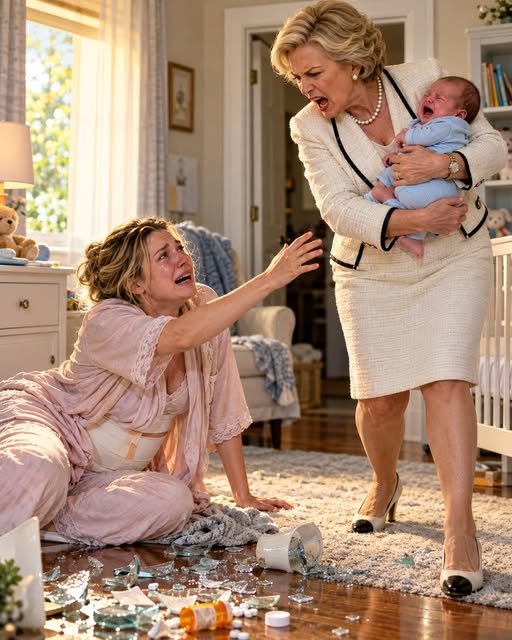
Eleanor was no longer beside Clara.
She was standing at the kitchen counter, calmly washing her hands.
Clara was still on the floor.
Leo was crying in his bassinet.
My wife tried to push herself upright.
She immediately winced and stopped.
“Don’t move,” I said, even though she couldn’t hear me through the camera.
I pulled into the driveway and got out.
Before I reached the front door, Audrey called again.
“It was Dad,” she said.
“What about him?”
“He knew something was wrong.”
I stopped walking.
“You said he didn’t know.”
“I said he didn’t know what she was doing to me,” Audrey replied. “That isn’t the same thing.”
I waited.
“He saw the bruises.”
My hand tightened around the phone.
“What did he do?”
“He asked her about them.”
“And?”
“She told him I was clumsy.”
Audrey took a shaky breath.
“Then she told him I was lying.”
I looked through the front window.
Eleanor was still in the kitchen.
She had changed nothing about her expression.
“She made me apologize to him,” Audrey continued. “I remember standing in the hallway with my hands behind my back because she told me not to move them.”
“Why?”
“Because I had scratches on my wrists.”
I closed my eyes.
“Where did they come from?”
“I tried to get away.”
The words sat between us.
Then Audrey said, “There was a woman who lived across the street. Her name was Margaret.”
“What did she see?”
“She saw me crying one night.”
“And she knew?”
“She tried to talk to Dad.”
“What happened?”
“My mother told Dad Margaret was trying to destroy our family.”
I looked at our house again.
The same pattern.
The same explanation.
The same woman standing in the center of everything while everyone else was taught to doubt themselves.
“Audrey,” I said, “why didn’t you ever tell me?”
“I did.”
I frowned.
“What?”
“When you were nine.”
I couldn’t answer.
“You asked me why I was scared of Mom,” she said. “I told you she hurt me.”
I felt something inside me shift.
“I don’t remember.”
“I know.”
Her voice softened.
“You were nine. She heard us talking.”
I leaned against my car.
“What happened?”
“She came into the room and laughed.”
Audrey paused.
“Then she told you I was being dramatic because I was jealous of her.”
I stared at the pavement.
There were pieces of my childhood suddenly rearranging themselves.
My sister spending more time at friends’ houses.
My mother calling her difficult.
My father becoming quieter.
The locked bathroom door.
The apologies.
The strange rule that nobody was allowed to question Eleanor in front of other people.
I had spent years calling those things family problems.
I had been wrong.
“Audrey,” I said, “I’m going inside.”
“Wait.”
“What?”
“If she realizes the camera is still working, she may destroy the evidence.”
I looked at my phone.
The feed was still live.
“I’m recording everything.”
“Then don’t confront her alone.”
I heard another voice in the background.
An older man’s voice.
My father.
“She’s right.”
I froze.
“Dad?”
He came onto the call.
“I should have protected you both.”
For the first time since I had received Audrey’s call, I felt my anger break.
Not disappear.
Break.
Because my father sounded like a man who had been carrying the weight of the same failure for decades.
“I thought keeping the peace was protecting the family,” he said.
“It wasn’t.”
“No.”
His voice cracked.
“It wasn’t.”
I looked toward the house.
“I have to get Clara out.”
“Then do that first.”
I opened the front door.
Eleanor turned.
She smiled immediately.
“There you are.”
I didn’t answer.
My eyes went straight to Clara.
She was still on the floor.
“Clara.”
She looked at me.
For one second, neither of us spoke.
Then her face crumpled.
I crossed the room and dropped beside her.
“Don’t move,” I whispered.
“I tried.”
“I know.”
“I couldn’t reach Leo.”
“I know.”
I helped her carefully into my arms without putting pressure on her abdomen.
Eleanor watched us.
“You’re making this into something it isn’t,” she said.
I looked at her.
“You crushed her medication.”
Her smile disappeared.
“You don’t know what happened.”
“I watched it happen.”
She stared at me.
Then she glanced toward the nursery.
Something changed in her face.
Not fear.
Calculation.
“You’ve been spying on me?”
“I’ve been documenting what happens in my house.”
“This is my grandson.”
“He is my son.”
She folded her arms.
“I was helping.”
“Helping?”
“She needs discipline.”
Clara made a small sound beside me.
I looked down.
Her eyes were closed.
She was trying not to cry.
I stood.
“Eleanor, put Leo down.”
“He’s upset.”
“Put him down.”
“You’re being emotional.”
“No.”
I pointed toward the bassinet.
“You’re leaving.”
She laughed once.
“After everything I’ve done for this family?”
“You’re leaving.”
Her expression hardened.
“You’ll regret humiliating me like this.”
I didn’t answer.
I picked up Leo.
He was still crying.
The second I held him against my chest, he grabbed the fabric of my shirt with one tiny fist.
Eleanor watched.
Then she said something I will never forget.
“You think you’re protecting them from me.”
She stepped closer.
“But you don’t even know what happened in this family.”
I stared at her.
“My sister told me.”
For the first time, Eleanor’s face changed.
Only slightly.
But I saw it.
The certainty disappeared.
“You talked to Audrey?”
“Yes.”
She looked toward the window.
Then back at me.
“She has always hated me.”
“She says you hurt her.”
“She was a difficult child.”
Clara spoke from behind me.
“She wasn’t.”
Eleanor looked at her.
Clara was still weak.
Still pale.
But her voice didn’t shake.
“She told me everything.”
My mother laughed softly.
“Of course she did.”
Then she looked at Clara.
“You have no idea what you’re talking about.”
“I know enough.”
Eleanor took one step toward her.
I moved between them.
“Don’t.”
She stopped.
A minute later, the doorbell rang.
Two officers stood outside.
Behind them was an ambulance.
I had called both before entering the house.
I hadn’t told Eleanor.
The paramedics went straight to Clara.
She tried to tell them she was fine.
They ignored her.
One of them examined the bruising around her abdomen and asked what had happened.
I answered.
Then he asked about the medication.
I pointed toward the broken glass.
The crushed pills were still there.
Nothing had been cleaned.
Nothing had been moved.
That was the first time Eleanor seemed to understand that the scene she had created was now evidence.
She started talking quickly.
“She dropped the glass.”
“She tried to pick it up.”
“She was confused.”
“She gets emotional since the baby.”
The officer looked at me.
Then at her.
Then at the camera mounted near the nursery.
“Is that recording?”
“Yes,” I said.
Eleanor’s face went still.
The officer asked to see the footage.
I handed him my phone.
He watched the beginning.
Then the middle.
Then the moment Eleanor picked up Leo and stepped away from Clara.
He stopped the video.
“Ma’am, please step outside.”
Eleanor stared at him.
“You don’t understand.”
“Outside.”
“I am the grandmother.”
“I understand.”
She looked at me.
There was no anger in her face now.
Only disbelief.
“You would do this to your own mother?”
I held Leo closer.
“You did this to my wife.”
That was all I said.
The ambulance took Clara to the hospital for evaluation.
Leo went with us.
Eleanor was taken away for questioning.
She wasn’t arrested that day.
There was an investigation first.
Medical records.
Camera footage.
Messages.
Photos.
The medication.
The broken glass.
And Audrey’s statement.
Then something happened that I hadn’t expected.
Margaret, the woman who had once lived across the street from my childhood home, was found.
She was seventy-eight.
She remembered Audrey.
She remembered my mother.
And she remembered the night she had tried to help.
She still had an old letter my father had written her decades earlier.
He had apologized for not believing her at the time.
That letter became part of the investigation.
My father finally told the truth about what he had seen.
Not everything.
Not at first.
But enough.
He admitted that he had spent years avoiding conflict because he was afraid of what would happen if he challenged Eleanor.
He admitted that he had failed Audrey.
And he admitted that he had failed me by teaching me to mistake silence for peace.
Audrey didn’t forgive him immediately.
Neither did I.
But he kept showing up.
He went to the hospital.
He sat outside Clara’s room.
He brought coffee.
He never asked us to forgive him.
That mattered.
Clara recovered slowly.
Her doctor extended her restrictions.
For several weeks, she couldn’t lift Leo.
So I did.
I fed him.
I changed him.
I walked him around the living room at three in the morning.
And every time he cried, I remembered the way Eleanor had used his crying against his mother.
I made sure Clara never heard that accusation again.
Not from me.
Not from anyone.
Months later, Audrey and I sat together at my kitchen table.
There was no Eleanor in the house.
There was no pretending.
She showed me old photographs.
In some, she was smiling.
In others, she wasn’t.
She told me things I had never known.
Some were small.
Some weren’t.
I listened.
I didn’t try to repair her memories.
I didn’t tell her she should forgive.
I just listened.
At one point, she looked at me.
“You really don’t remember me telling you when we were kids?”
I shook my head.
“No.”
She nodded.
“I used to think that meant you didn’t care.”
“I was a child.”
“I know.”
She reached across the table.
“I know that now.”
We sat there quietly.
Then she said, “I’m glad you believed Clara.”
I looked down at my hands.
“So am I.”
The legal process took months.
Eleanor eventually lost unsupervised access to Leo.
The family relationships changed permanently.
Some relatives stopped speaking to us because they believed Eleanor’s version.
Others quietly admitted they had noticed things for years.
Nobody got the clean ending people imagine in stories like this.
There was no single courtroom speech that repaired decades of damage.
There was no apology that erased what happened.
There was only distance.
Boundaries.
Evidence.
And the decision to stop protecting the person causing the harm.
One afternoon, Clara and I sat outside with Leo.
He was old enough to crawl by then.
He moved across the blanket toward a wooden toy truck my father had given him.
Clara watched him.
“You know,” she said, “I still hate broken glass.”
I looked at her.
She smiled.
“I know.”
I had replaced the hardwood floor in that room.
The new boards were lighter than the old ones.
But I kept one small piece of the original wood.
Not the glass.
The wood beneath it.
The place where Clara had been sitting when I first saw her through that hidden camera.
I kept it because I didn’t want to remember the humiliation.
I wanted to remember the moment I finally stopped explaining Eleanor’s behavior away.
Leo grabbed the toy truck and pushed it across the new floor.
Clara reached for his hand.
This time, nobody stopped her.
She pulled him into her arms.
And as I watched them together, the house was quiet.
Not the dangerous kind of quiet I had grown up with.
A different kind.
The kind that comes when nobody is waiting for someone else to explode.
On the table beside me, my phone lit up.
For a second, I expected another camera alert.
Instead, it was a message from Audrey.
Three words.
“We’re safe now.”
I turned the phone face down.
Then I watched my son push the little wooden truck across the floor again.
The wheels made a soft clicking sound against the new boards.
And for the first time, that was the only sound in the house that I wanted to hear.