My Stepson Called Me Useful Before Losing His House At Sunrise
PART 3 (FULL STORY)
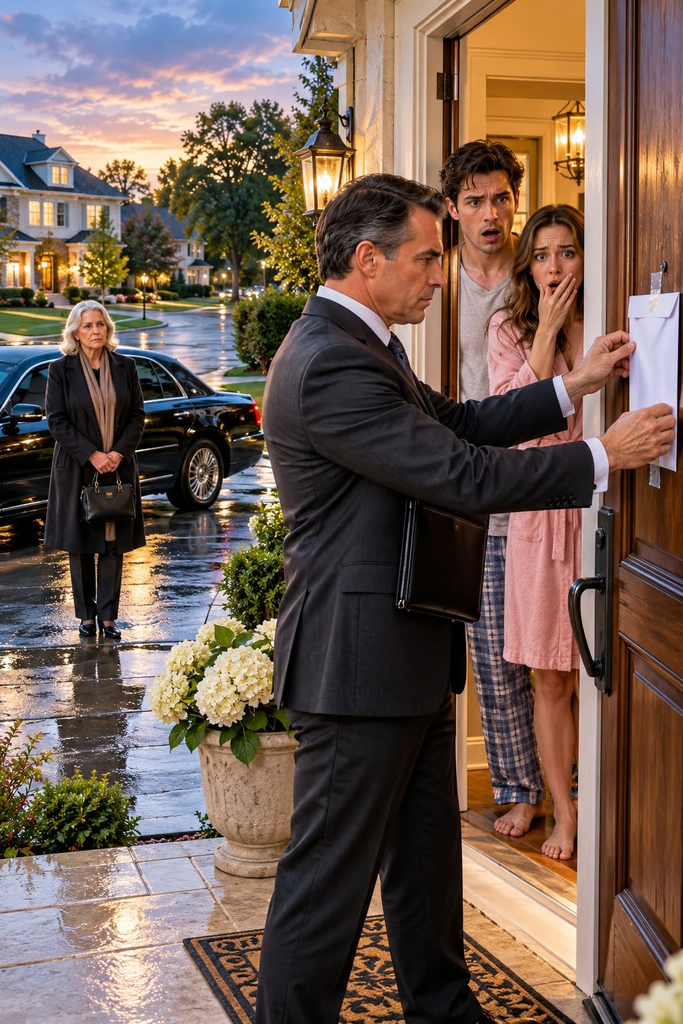
“Mom! Mom, what is happening?” Evan’s voice cracked through the receiver, completely stripped of the smug arrogance I had heard through his kitchen window only ten hours earlier. In the background, I could hear Marissa screaming at the process server on the front lawn. “There’s a man here taping foreclosure notices to our door! He says you own the note on our house and you’re demanding three hundred and eighty thousand dollars!”
I sat quietly at my sunny breakfast table, sipping hot tea from a porcelain cup while looking out at my back garden.
“It isn’t a mistake, Evan,” I said, my voice calm and completely devoid of emotion. “Six years ago, when your second restaurant collapsed and the bank was forty-eight hours away from seizing your home, Arnold drafted private bridge loan agreements for every check I wrote. You were in such a hurry to take my money that you never bothered to read the clauses above your signature. I didn’t gift you those bailouts; I purchased the senior lien on your property.”
Silence hung on the line for three heavy seconds before Evan spoke again, his tone shifting from panic to desperate manipulation. “Mom, please… we just brought the baby home. We’re family! We were supposed to have dinner Friday night to go over the estate trust!”
“I was on your porch last night at eight-thirty, Evan,” I replied softly. “I had a two-hundred-and-fifty-thousand-dollar cashier’s check in my purse for the baby’s future. Then I stopped by the kitchen window and heard you and Marissa laughing about putting the ‘old bat’ into a cheap state nursing home the second I signed the trust over.”
I heard Evan’s breath catch in his throat.
“You said letting me hold my grandson for photos made me feel useful,” I continued evenly. “Well, yesterday I decided to stop being useful to people who view my life as a waiting game. The two-hundred-and-fifty-thousand-dollar check has been redeposited into an irrevocable charitable endowment for pediatric hospital wards. My will has been amended to leave you exactly one dollar. And as for the house, you have thirty days to refinance the three hundred and eighty thousand dollars you owe me through a commercial bank, or Arnold will execute the foreclosure auction.”
“You can’t do this to us!” Evan shouted, the mask of the loving son finally shattering into raw fury. “My father left you that money! That’s my birthright!”
“Your father died leaving forty thousand dollars in medical debt that I paid off with my own pension and investments,” I corrected coldly. “Everything I have, I earned and grew myself. Maybe two nice dinners and calling a loan officer ‘Mom’ will melt the bank into giving you a third mortgage. Goodbye, Evan.”
I ended the call and blocked both his and Marissa’s numbers.
Over the next four weeks, Arnold Pierce handled every detail with clinical efficiency. Because Evan had two failed businesses, dismal credit scores, and mountains of consumer debt from Marissa’s lavish spending, no bank in the state would approve them for a refinancing loan. Instead of allowing the property to go to a public sheriff’s auction—which would have destroyed whatever minimal equity remained—Evan and Marissa were forced to sign a deed in lieu of foreclosure to avoid deficiency judgments.
On the thirtieth day, a commercial moving van backed into the driveway of the house I had paid for. From across the street, Arnold’s property manager supervised the handover of the keys while Evan and Marissa loaded their belongings into a rented truck, bound for a cramped two-bedroom apartment across town where Marissa finally had to apply for a full-time retail job.
When the house was officially vacant and the locks were changed, I walked through the empty rooms one final time before the real estate stagers arrived. The house was quiet, the polished hardwood floors gleaming in the afternoon light. When I stepped into the kitchen, I noticed one item left behind in the back of the lower corner cabinet, forgotten amidst their frantic packing.
It was the blue ceramic mug with the tiny white sailboat painted on the side, still chipped near the rim.
For a long moment, I held it in my hands, remembering the ten-year-old boy who used to hide from thunderstorms under a wool blanket while I warmed his milk. I realized then that the boy I had loved hadn’t been a lie—he was simply gone, replaced long ago by a greedy stranger who had forgotten who held his hand in the dark.
I set the mug gently inside the recycling bin, walked out the front door, and locked it behind me.
Two months later, the property sold to a wonderful young couple expecting their first child. I used the proceeds to fund a permanent scholarship program for nursing students in my late husband’s name, and spent the spring traveling down the coast of Italy with my two closest friends. Sitting on a sunlit terrace overlooking the Mediterranean Sea, I felt the warm breeze on my face and knew that for the rest of my days, my kindness would belong only to those who truly valued my heart.