My Parents Sued Me for the Family Farm Before Discovering My Hidden Protection
PART 3 (FULL STORY)
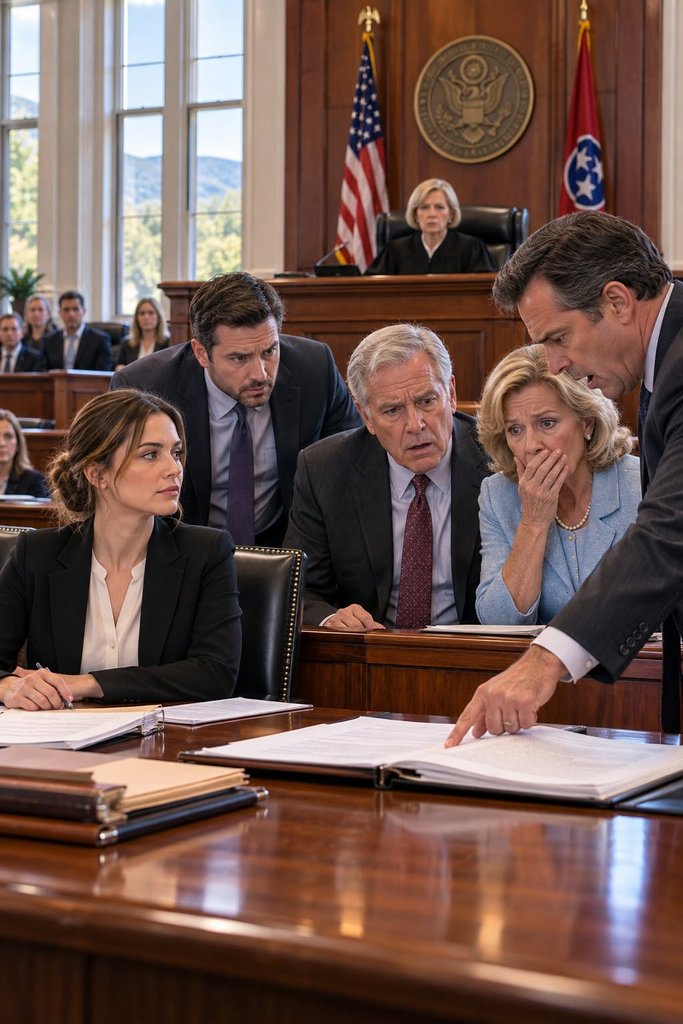
The ceiling fans in the small county courtroom rotated with a low, rhythmic creak, pushing the humid Tennessee morning air across the gallery benches. Across the center aisle, Harold Mercer remained frozen halfway out of his wooden chair, his knuckles white against the edge of the defense table. His lawyer, Bradley Stone, sat slouched over his briefcase, staring at the blue-sealed document from the county register of deeds as if it were a live grenade.
“Mr. Stone,” Judge Evelyn Harper said, her voice cutting through the suffocating stillness of the room like a cold blade. “Is there an issue with the decree your firm drafted and submitted to this court for entry?”
Bradley Stone swallowed hard, his Adam’s apple bobbing nervously above his starched collar. He looked at Harold, then at Diane, who was frantically clutching her pearl necklace with trembling fingers. “Your Honor… my clients were under the impression that an unconditional judicial rescission of the 2021 deed would restore the property to its pristine, unencumbered pre-transfer status.”
“The law of real property does not operate on personal impressions, counselor,” Judge Harper replied, adjusting her glasses and tapping the heavy legal volume on her bench. “Under Tennessee Code Annotated, a rescission of a voluntary conveyance restores legal title to the grantors subject to all valid intervening liens, recorded covenants, and easements established during the period of valid legal ownership. Your clients specifically petitioned for the rescission of the deed, and Ms. Claire Mercer consented. The order is signed, recorded, and final.”
Harold found his voice, though it cracked with furious disbelief. “Wait! No! Judge, you don’t understand! We have a signed commercial option with a logistics warehouse syndicate out of Knoxville! They wired two hundred and fifty thousand dollars into our escrow account as an earnest money deposit! We’re scheduled to close the sale for two point four million dollars on the first of next month!”
“You signed a commercial purchase agreement for agricultural land you didn’t legally own, Mr. Mercer?” Judge Harper asked, her eyebrows arching with severe judicial disdain. “That sounds like an issue between you, your buyer, and the district attorney’s consumer fraud division. It has no bearing on the decree entered in this courtroom.”
Jonah Pierce leaned back in his chair beside me, a broad, triumphant grin spreading across his face. He finally understood why I had spent eleven months refusing to argue, refusing to present maintenance logs, and refusing to contest my parents’ bitter accusations.
Two years earlier, while auditing Grandma Ruth’s cedar filing cabinet, I had uncovered her original journals from the 1960s. Grandma Ruth had written extensively about the predatory developers who had carved up the neighboring ridges into gravel pits and asphalt truck stops. She had made my father promise on his twentieth birthday that Cedar Hollow would remain green pasture as long as a Mercer drew breath. But the moment my father tasted the prospect of seven figures, Grandma Ruth’s sacred promise became an inconvenient obstacle.
When Harold had deeded the farm to me to avoid probate and shift the tax burdens onto my shoulders, I realized that my ownership was the only shield the land would ever have. Within four months of receiving the deed, I contacted the Land Trust for Tennessee. I spent six months working with state environmental surveyors, cataloging the natural springs, the hardwood timber groves, and the prime agricultural soils. In November of that year, I executed an irrevocable conservation easement in perpetuity, legally binding the forty-two acres forever. The land could be farmed, it could be grazed, and it could be passed down through families, but it could never be subdivided, rezoned for industrial use, or bulldozed for a warehouse depot.
Furthermore, over the three years I had managed the property, I had invested two hundred and twelve thousand dollars of my personal savings into restoring the farm. I had replaced the rotting timbers on the bank barn, installed a new tin roof on the farmhouse, drilled a two-hundred-foot agricultural well, and paid off five years of deferred county property tax liens that Harold had hidden in the bottom of a pantry cabinet. To protect those investments, my attorney had recorded a formal construction deed of trust and promissory note against the property title.
“Harold,” Bradley Stone whispered, his voice trembling so loud that every spectator in the front two rows could hear. “The logistics developer contracted for unencumbered commercial acreage. Because of the conservation easement, the land cannot legally support a warehouse. They will terminate the contract on Monday morning, demand the immediate return of their two-hundred-and-fifty-thousand-dollar deposit, and sue you for breach of contract and legal fees.”
Stone turned the document toward Diane, pointing at the second recorded encumbrance. “And because you rescinded the deed, you have legally assumed Claire’s senior deed of trust. You now personally owe your daughter two hundred and twelve thousand dollars, secured by a first-position lien against the farmhouse, payable in full within thirty days.”
Diane let out a choked shriek, dropping her purse onto the floor as tears began to stream down her face. “Claire! How could you do this to us? We’re your parents! We gave you life!”
I stood up from the defendant’s table, smoothing the fabric of my dark trousers. I looked across the aisle at my mother and father. For nearly a year, they had told our neighbors, our church pastor, and our extended family that I was an ungrateful daughter who had stolen their home. They had dragged me through court, hoping to humiliate me and cast me aside the moment corporate money waved in their faces.
“You didn’t give me life, Mom,” I said softly, my voice completely steady, carrying through the vaulted ceiling of the quiet courtroom. “You used my credit to pay your back taxes, you used my labor to repair your roof, and then you hired a lawyer to throw me away the second you thought you could cash out Grandma Ruth’s memory for a developer’s check.”
Harold stumbled around the table, reaching toward me with pleading hands, his face pale and hollow. “Claire… please. You have to dissolve the easement. Talk to the state! Tell them it was a mistake! If the developer sues us, we’ll lose everything! We don’t have the deposit money anymore—we spent it on our retirement accounts and the new truck!”
“An irrevocable conservation easement cannot be dissolved by a grantor, Harold,” Jonah Pierce intervened, stepping smoothly between my father and me. “It is held in public trust by the state of Tennessee. Not even the governor can undo it. And my client will be filing a formal notice of foreclosure on her promissory note if her two hundred and twelve thousand dollars is not paid by the thirty-day deadline.”
Judge Harper struck her wooden gavel with a loud, resounding crack that silenced the courtroom instantly. “Court is adjourned,” she declared, rising from the bench and disappearing into her chambers.
The hallway outside the courtroom was bathed in the warm, golden light of early autumn. Spectators from our town filed out in awkward silence, averting their eyes from Harold and Diane, who were sitting on a wooden bench weeping in utter ruin. Their lawyer was already packing his briefcase, telling them in hushed, urgent tones that they needed to retain a bankruptcy specialist before the developers filed their fraud complaint in federal court.
I walked down the broad marble steps into the crisp morning air, feeling a sense of absolute, unburdened freedom.
The legal fallout unfolded over the next four months with mechanical inevitability. The commercial logistics company terminated the purchase option and filed a lawsuit against Harold and Diane for fraudulent misrepresentation, freezing their personal bank accounts and placing a lien on their luxury vehicles. Facing complete financial devastation and unable to satisfy my recorded construction lien, my parents had only one viable option left to avoid losing the roof over their heads to public auction.
Through formal court-ordered mediation, Harold and Diane surrendered all residual life interests in the farmhouse and surrounding acreage to the Land Trust for Tennessee and to me. In exchange for forgiving the promissory debt and shielding them from eviction, I granted them a lifetime occupancy license in the small tenant caretaker cottage on the far north corner of the property, stripping them of every legal right to govern, encumber, or control the farm ever again.
By mid-October, the autumn weather had settled deeply into the valley. I moved my belongings out of my rental house and back into the master bedroom of the main farmhouse at Cedar Hollow.
Late on a Saturday afternoon, I stood on the wide front porch beneath the tin roof, holding a warm mug of black coffee. Along the east driveway, the magnificent sugar maples had turned into a blazing canopy of orange, gold, and crimson, their leaves rustling softly against the cool mountain breeze.
In the corner of the porch, nestled against the white clapboard siding, sat Grandma Ruth’s old wooden rocking chair, freshly oiled and solid against the floorboards.
The greed that had threatened to tear the soil apart had burned itself out, leaving behind only the quiet, unbroken land. The fence posts stood straight, the pastures stretched out green and undisturbed beneath the rolling hills, and the farm was finally home—protected, peaceful, and free forever.