My Mother Ambushed My Son’s Baptism Before I Revealed Her Thirty-Year Secret
PART 3 (FULL STORY)
The paper in my fingers was crisp, stamped with the blue seal of the Franklin County Probate Court. For three decades, my mother had ruled our extended family like an absolute monarch, using my late grandfather Arthur’s memory as both a shield and a weapon. Whenever anyone questioned her financial decisions, her social demands, or the way she dictated holidays, she invoked her father’s name. Arthur had been a prominent commercial builder in central Ohio, a self-made man who left behind a considerable estate and an impeccable reputation. When he passed away thirty years ago, Margaret took charge of everything, presenting herself as the selfless steward who sacrificed her own ambitions to keep the family afloat.
None of us ever thought to question her. We were taught from childhood that Grandmother was fragile and Mother was our protector. Every cousin who went to college received a modest check from Margaret, handed over with a solemn lecture about honoring Arthur’s hard work. Every family gathering took place where she dictated, on her terms, under her watchful eye. When Daniel and I married three years ago, she tried to choose our venue, our caterer, and our guest list. We held our ground, paying for the wedding ourselves and keeping the ceremony small. She never forgave us for that independence, but when I became pregnant, her interference turned into an obsession.
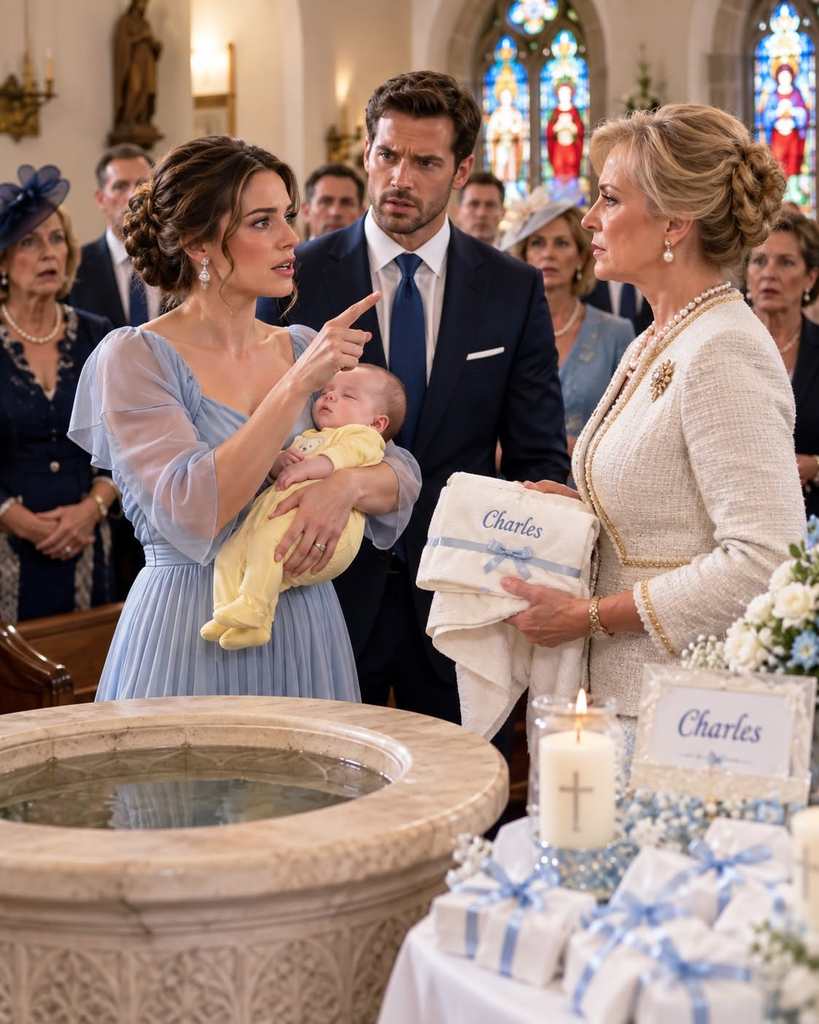
From the moment our twenty-week ultrasound confirmed we were expecting a boy, Margaret began her campaign. She arrived at our house with antique leather scrapbooks, monograms, and family trees dating back to the late nineteenth century. She informed us that our son would be named Charles Arthur, continuing the unbroken line of firstborn grandsons. When Daniel and I gently told her we had already decided on Julian Thomas—honoring Daniel’s father, a quiet carpenter who had spent forty years working with his hands to provide for his family—she dismissed it as a juvenile joke. Over the following months, the pressure escalated from polite suggestions to icy lectures, and eventually to veiled ultimatums. She told me that if we refused to honor my grandfather, she would consider it a deliberate act of disrespect and sever our ties to the family estate.
We refused to bend. We filed Julian’s birth certificate with the state the day after he was born, and when we scheduled his baptism at St. Andrew’s, we submitted the paperwork directly to Father Michael. We thought the matter was settled. What we didn’t know was that Margaret had visited the church rectory earlier that very morning. While Daniel and I were at home dressing our baby in his christening gown, Margaret had arrived forty minutes before Mass, carrying a donation check and an unauthorized registration form filled out in her own handwriting, attempting to convince the parish secretary that we had changed our minds at the last minute.
Father Michael looked from the legal probate document in my hand to the binder on the lectern, his expression settling into calm authority. He adjusted his glasses and turned his gaze directly toward my mother. “Margaret,” he said in a measured voice that echoed off the stone walls, “the sacrament of baptism is an entrance into the truth of Christ. It cannot be built on an ambush, nor can it be founded on deception. When you handed me an envelope in the sacristy this morning, you assured me that your daughter and son-in-law had consented to an amendment. I told you then that only the parents have the right to name their child before God.”
A soft rustle ran through the nave as my aunt Clara leaned forward in her pew, her eyes wide with shock. Margaret’s face transformed from indignant rage into pure panic. She took a step toward me, reaching out to grab my arm, but Daniel stepped between us. His voice remained low and steady, without a trace of hesitation. “You didn’t want the name Charles Arthur out of family pride, Margaret,” Daniel said, loud enough for every relative in the first five rows to hear. “You wanted it because of the clause in Arthur’s original 1994 testament.”
The secret had come to light two weeks earlier, entirely by accident. Daniel and I had been setting up our own wills and appointing guardians for Julian, working with an estate attorney who specialized in trust administration. When our attorney pulled the historical county records to verify beneficiary clauses connected to my grandfather’s original trust, he uncovered an astonishing truth. Grandfather Arthur had not left his wealth to Margaret to distribute at her whim. He had established an equal educational trust for all eight of his grandchildren, naming Margaret as a temporary custodian until the eldest grandchild reached thirty years old.
That deadline had passed four years ago. Margaret was legally required to distribute the principal among my cousins and me. Instead, she had filed three separate extensions claiming the beneficiaries were still unsettled, using trust assets to fund her luxury country club memberships, her European cruises, and the sprawling suburban house she claimed she kept solely for family holidays. There was only one contingency in Arthur’s will that would have allowed her to retain lifetime control of the trust: if a direct male descendant were born and legally christened as Charles Arthur before the final probate closure, the trust could be restructured into a perpetual family estate under Margaret’s sole stewardship.
“You spent thirty years pretending you were helping this family,” I said, looking directly into my mother’s eyes as she stood frozen on the sanctuary steps. “In reality, you took the money my grandfather left for all of us. You spent four years hiding the final distribution court order, hoping you could force us to name our son after him so you could keep living off his legacy without anyone ever finding out.”
Silence hung over the church, heavy and suffocating. My cousin Mark, who had taken out fifty thousand dollars in student loans for medical school while Margaret lectured him on frugality, stood up from his pew. Aunt Clara stared at the monogrammed blanket in her lap as though it had caught fire, then dropped it onto the wooden kneeler. Margaret looked around desperately, searching for an ally among her brothers, sisters, nieces, and nephews, but every face she met had turned to stone. The illusion of the benevolent matriarch had shattered completely in less than two minutes.
Without uttering another word, Margaret gathered her designer purse from the front pew. The proud, imposing posture she had carried for decades was gone, replaced by a frantic, hollow retreat as the heels of her leather pumps clicked sharply down the center aisle. When the heavy oak doors of St. Andrew’s swung shut behind her, the church fell silent once more.
Father Michael stood beside the baptismal font, waiting patiently until the tension settled. He looked at Daniel and me with gentle warmth. “Are you ready to present your son?” he asked softly.
Daniel nodded, resting his hand against my shoulder. We stepped up to the stone font, where the holy water caught the morning light streaming through the stained glass windows. Father Michael asked the ancient questions, and Daniel and I answered together, our voices clear and unwavering. When the priest asked, “What name do you give your child?” I looked down at the peaceful face of our sleeping boy.
“Julian Thomas,” I replied.
Father Michael poured the water three times over Julian’s forehead, baptizing him in the name of the Father, the Son, and the Holy Spirit. Julian let out a small, startled cry before settling back against my chest, comforted by the warmth of Daniel’s embrace. In the pews behind us, there was no dramatic applause, only the quiet, genuine relief of family members who had finally seen through a long web of manipulation.
After the ceremony, we did not go to the extravagant country club banquet Margaret had booked to showcase her manufactured victory. Instead, Aunt Clara, my cousins, and Daniel’s parents followed us back to our modest home on the north side of Columbus. We ordered sandwiches, made pots of fresh coffee, and sat in our living room talking openly for the first time in years. Aunt Clara called our attorney that afternoon to join the probate filing, determined to ensure that every penny Arthur had left for the younger generation was properly audited and distributed.
Later that evening, after the last of our relatives had gone home and the house grew quiet, Daniel and I stood together in Julian’s nursery. Across the foot of his crib lay the plain white cotton blanket Daniel’s mother had knitted by hand, unadorned by grand titles or manufactured legacies. Julian slept soundly beneath it, carrying only the name we had chosen with love, untainted by anyone else’s ambition.