My Husband Gave Me A Forty Dollar Allowance Before The Bank Froze Him
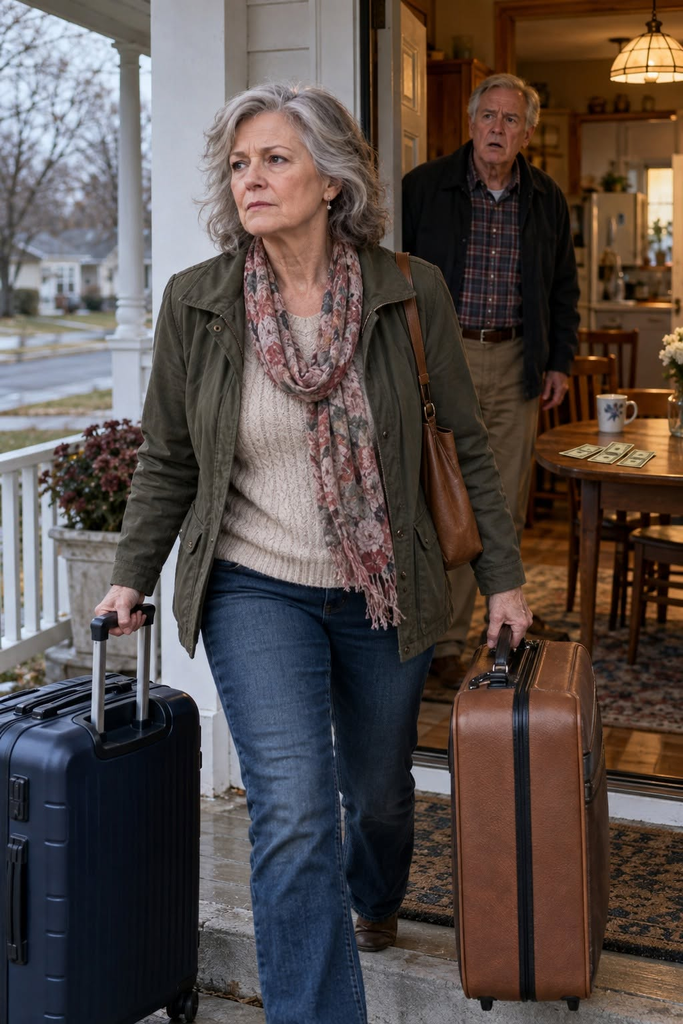
PART 3 (FULL STORY)
The muffled shouting through the speaker of my phone echoed against the quiet walls of Sarah Jenkins’ law office. Douglas sounded like a drowning man grasping at air, the composed, dependable facade he had maintained for four decades completely unraveling into desperate hysteria. For forty-one years, I had believed Douglas was an immovable pillar of security. Sitting across from my attorney with my certified pension records spread out before me, I finally saw the truth: my husband was a reckless gambler who used financial control as a cage to conceal his ruin.
“Miriam, please!” Douglas pleaded, his voice breaking into breathless gasps. “You don’t understand the market! The trade was supposed to rebound this morning! If the brokerage doesn’t receive eighty thousand dollars by noon, they will liquidate our entire equity portfolio and attach a lien to the house! You have to lift the freeze!”
“I spent thirty-one years working twelve-hour shifts on pediatric wards, Douglas,” I replied, my voice steady and cold. “You convinced me to hand over my pension so you could pay off margin debt. You cut up my cards, tracked my mileage to see my friends, and gave me four ten-dollar bills a week while you flushed our life savings down an offshore trading hole. The freeze stays.”
I ended the call and placed the phone face down on the desk. Sarah Jenkins, an experienced domestic relations attorney who had helped dozens of women reclaim their autonomy, slid a fresh set of signature tabs toward me.
The previous afternoon, while looking for our homeowner’s insurance policy in the metal filing cabinet Douglas always kept locked in the basement, I had discovered an unsealed master key taped beneath the worktable. Inside the bottom drawer lay the horrifying reality of our retirement. Douglas hadn’t been practicing prudent budgeting; he had lost one hundred and eighty thousand dollars of our joint savings over eighteen months chasing speculative options on an unregulated overseas trading platform. To conceal the mounting losses, he had transferred my monthly two-thousand-four-hundred-dollar pension into his private brokerage clearing account, systematically isolating me from our finances so I wouldn’t discover the empty accounts.
“We caught it just in time, Miriam,” Sarah explained gently. “Because we filed the emergency ex-parte financial restraining order at eight this morning, your pension has been permanently redirected back to a private account under your sole name at First National. Furthermore, the court has placed a lis pendens on the marital home and frozen the primary accounts. Any further unilateral losses will be attributed exclusively to Douglas in the final equitable distribution.”
After leaving Sarah’s office, I didn’t hide in fear. I drove straight to the home of my oldest friend, Joanie Mercer. Joanie met me at the door with open arms, a hot pot of tea, and a spare bedroom already made up with fresh floral sheets. For the first time in three years, I sat at a kitchen table without looking at a clock, without calculating four-dollar coffees in my head, and without dreading an interrogation about who I had spoken to.
Later that afternoon, my daughter Caroline called from Oregon, her voice thick with emotion. Douglas had called both our children, spinning frantic lies about how I had suffered a nervous breakdown and vanished with the family savings. But Caroline and Evan weren’t fools.
“Mom,” Caroline said softly, “Evan and I just saw the bank statements you forwarded to our email. We are so proud of you for leaving. He’s been suffocating you for years, and we could see it every time we visited. You don’t owe him a single penny of your life.”
Over the following four months, the legal proceedings stripped away every layer of Douglas’s control. Confronted with forensic bank audits, the court determined that Douglas had committed egregious financial dissipation of marital assets. To settle the outstanding debts and finalize the divorce, our white house with the deep front porch was placed on the market. The proceeds were split, but Douglas’s share was heavily docked to reimburse the tens of thousands of dollars he had illegally siphoned from my pension.
When the final decree was signed in judge’s chambers that autumn, Douglas looked like a ghost of the man I had married. His tailored clothes hung loosely on him, his hair was unkempt, and he sat alone at the respondent’s table without a single friend or family member beside him. He tried to approach me in the courthouse hallway, attempting one last time to summon his old patronizing tone.
“You threw away forty-one years over pride, Miriam,” he said, adjusting his glasses with trembling hands. “You think you’re going to survive on your own at sixty-three?”
I looked at him, feeling no anger, no hatred, and not a trace of regret.
“I survived thirty-one years of saving children’s lives, Douglas,” I said quietly. “Surviving without you is the easiest thing I will ever do.”
I turned on my heel and walked out through the heavy bronze doors of the courthouse into the crisp October sunshine. My son Evan was waiting by the steps, smiling as he loaded my bags into his car to drive me down to Nashville for an extended stay in his guest cottage before I finalized my new apartment near Caroline in Oregon.
As we merged onto the highway, I opened my purse and pulled out the old leather wallet I had carried for decades. I didn’t have to count crumpled bills, ask for permission, or apologize for existing. I rolled down the window, let the cool autumn breeze brush across my face, and smiled at the wide-open road ahead.