My Father Stranded Me and My Newborn Before Military Police Surrounded His Truck
PART 3 (FULL STORY)
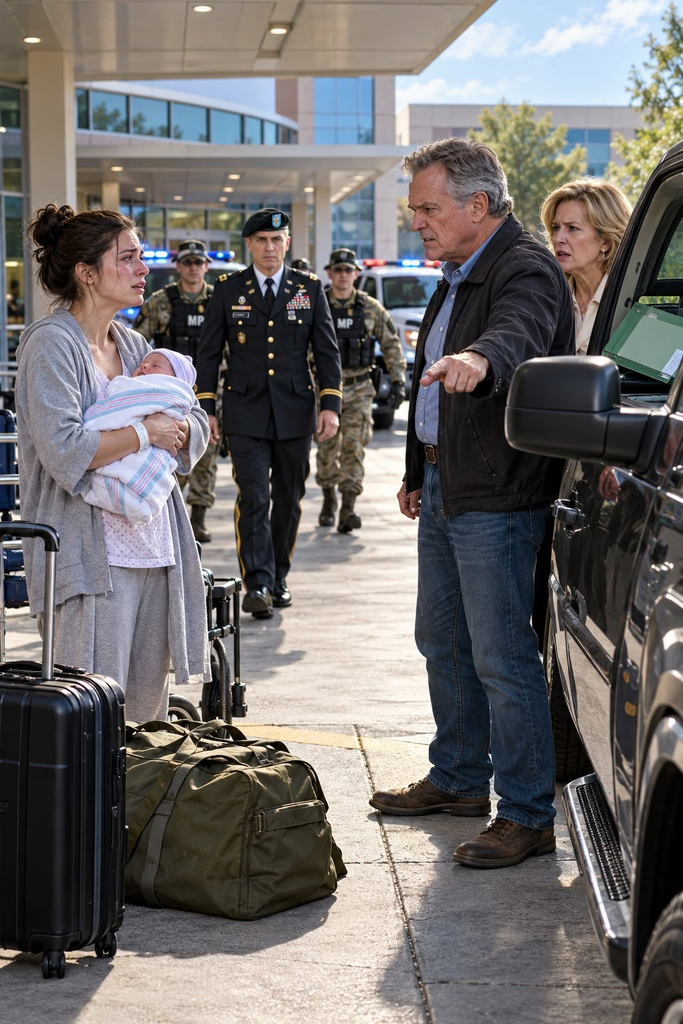
The flashing blue and red emergency lights bounced off the exterior glass of the hospital entrance, cutting through the morning fog that hung over the military reservation. My father stood rooted to the pavement beside his Chevy Silverado, his hands raised in surrender, his mouth opening and closing without sound. Beside him, my mother had backed herself flush against the limestone wall of the hospital wing, clutching her designer leather bag as if it could somehow shield her from the four armed soldiers who had completely sealed off the drop-off lane.
“Major, please! There has to be an administrative mistake!” my father stammered, his voice climbing into a high, cracking register as the lead military police officer patted him down against the driver’s side door. “I’m this soldier’s father! I drove my daughter to this hospital so she could give birth! I’m the primary caregiver helping her transition back into civilian life!”
Major Thomas Sterling did not raise his voice. He stood with his hands clasped behind his back, his camouflage uniform crisp and immaculate, looking down at my father with the cold, unyielding scrutiny of a battalion commander addressing a saboteur.
“Mr. Vance,” Major Sterling said, his voice quiet yet carrying the weight of absolute federal authority, “your daughter served five honorable years in the United States military. Her husband, Sergeant First Class David Miller, was killed in action six days ago while defending his platoon in the Euphrates river valley. You do not hold military credentials. You entered this federal installation under an emergency dependent visitor pass sponsored by your daughter. At ten-fifteen this morning, that sponsorship was formally terminated.”
The second military police officer reached through the driver-side window of the Silverado, lifted David’s thick green tactical folder from the dashboard, and carried it back to Major Sterling. The major opened the brass clasp, verified the contents—the official casualty assistance records, the Servicemembers’ Group Life Insurance forms, and David’s sealed estate instructions—and closed it firmly before walking over to where I stood on the sidewalk.
He gently took my duffel bag from the pavement, handed the green folder to me, and gave me a respectful, solemn nod. “Mrs. Miller, your husband was an exceptional non-commissioned officer. On behalf of the entire battalion, I assure you that no one will ever touch his legacy or your daughter’s future.”
My mother pushed away from the wall, her face flushed with indignant rage. “This is absurd! David is dead! He was an enlisted boy from an ordinary family! My husband broke his back for thirty years building a reputable commercial garage in this county! We took care of our daughter while she was pregnant! We have a legal right to oversee the financial distribution of his estate to ensure she doesn’t squander it on bad choices!”
Special Agent Marcus Vance from the Army Criminal Investigation Division stepped forward from the unmarked sedan parked behind the patrol units. He unzipped a black leather folder and produced three printed documents bearing the official watermark of the Department of Defense.
“Mrs. Vance,” Agent Vance stated, looking directly into my mother’s eyes, “at three o’clock on Friday afternoon, while your daughter was undergoing an emergency surgical Cesarean section under general anesthesia, an electronic power of attorney application was submitted to the Defense Finance and Accounting Service website. The application utilized David Miller’s restricted casualty identification numbers and attempted to reroute the four-hundred-thousand-dollar SGLI life insurance benefit to an account registered at the First National Bank of Pennsylvania.”
Agent Vance tapped the bottom of the page. “The destination account belongs to Vance Commercial Auto Repair, LLC. The primary signatory is Arthur Vance. The secondary authorized user is Evelyn Vance. Furthermore, on Saturday morning, Arthur Vance placed a recorded telephone call to the regional casualty assistance officer claiming that Mrs. Miller had experienced severe postpartum cognitive failure and requested that she be placed under immediate involuntary financial conservatorship.”
A heavy, suffocating silence fell over the curb. My father’s knees visibly buckled against the tire of his pickup truck.
“That constitutes federal wire fraud, identity theft of a deceased active-duty service member, and attempted grand larceny against the United States government,” Agent Vance said. “You have the right to remain silent. Anything you say can and will be used against you in a court of law.”
The steel handcuffs clicked shut around my father’s wrists with a final, resonant snap. He turned his head frantically toward me, his face pale and contorted with pathetic desperation. “Sarah! Tell them to stop! I’m your father! I put a roof over your head for eighteen years! You can’t let them take me to a military brig! The shop will default on its loans by Monday if I’m in jail!”
I looked down at the tiny face of my newborn daughter, sleeping peacefully beneath the woolen army-issue blanket against my heart, and then looked straight into my father’s terrified eyes.
“For five years after I enlisted, Dad, you demanded four hundred dollars a month from my military paychecks, telling me that family helps family,” I said softly, my voice completely steady despite the burning ache in my incision. “You drained twenty-four thousand dollars from me to keep your business afloat, and the moment David gave his life for this country, you walked into my hospital room and tried to steal his sacrifice before he was even buried. You aren’t a father protecting his family. You are a predator who ran out of victims.”
Before my father could speak, a third vehicle pulled into the hospital loop. My younger brother, Derek, stepped out of my own sedan, holding my car keys high in the air. Behind him came three women wearing matching navy polo shirts bearing the insignia of David’s battalion Family Readiness Group.
Derek walked past my father without a single glance, stopping in front of me and wrapping both of his arms gently around my shoulders, careful not to press against my surgery bandages. “I unlocked your car from Dad’s garage and drove it straight here with base security clearance, Sarah,” Derek whispered, tears in his eyes. “I brought your spare infant seat, your clothes, and everything you left in your old bedroom. You’re never going back to that house again.”
My mother lunged toward Derek, her hands clawing at his denim jacket. “Derek! You traitor! How could you side with her against your own parents?”
“Because David died fighting for people who couldn’t protect themselves,” Derek snapped back, his voice thick with fury. “And you two tried to rob his widow while she was still bleeding on an operating table. Don’t ever call my phone again.”
The military police escorted my father and mother into the back of the patrol cruisers. Within minutes, the sirens cut off, the doors closed, and the vehicles pulled away toward the provost marshal’s headquarters, leaving the hospital entrance in profound, clean stillness.
The women from the Family Readiness Group stepped forward with warm smiles and open arms. Rachel Sterling, the major’s wife, gently helped me into the passenger seat of an air-conditioned command van, while another wife carefully loaded my baby into a safety-inspected infant seat in the back row.
“We have a guest cottage ready for you on post, Sarah,” Rachel said softly, squeezing my hand with genuine warmth. “The nursery is fully stocked. The pantry is full. The battalion doctor will come by this evening to check your surgical incision, and David’s platoon brothers are taking care of every single arrangement for the memorial service at Arlington. You and this baby will never be alone again.”
Over the six months that followed, the consequences fell upon my parents with relentless legal precision. The federal magistrate rejected my father’s bail request due to the flight risk associated with military fraud charges. Facing mandatory federal sentencing guidelines for aggravated wire fraud and identity theft, my father agreed to a plea deal that required full financial forfeiture, forcing the liquidation of his commercial garage to pay court costs and restitution. Both of my parents were issued permanent barment orders, prohibiting them from ever setting foot on any Department of Defense installation for the remainder of their lives.
With the unyielding support of the casualty assistance team, David’s military benefits were secured in an independent, protected trust fund established exclusively for our daughter’s future education and medical care.
By late autumn, I had settled into a quiet, sun-filled brick home on the bluffs overlooking the river, just five minutes outside the base gate where David had served. Derek visited every weekend, helping me plant roses along the fence and assembling furniture in the nursery.
Late one Sunday evening, while the rain tapped gently against the living room window, I sat in the rocking chair nursing our daughter, Davina. She looked up at me with David’s bright hazel eyes, letting out a soft, contented sigh before curling her tiny fist against my thumb.
On the wooden mantel above us rested David’s green tactical folder, now resting safely beneath a shadowbox holding his silver dog tags, his combat infantry badge, and the folded American flag that had draped his casket.
The greed and cruelty that had attempted to break us had been completely vanquished by honor and truth. The road ahead would be long, but in the warmth of our home, my daughter would grow up knowing that her father was a hero, her mother was unbroken, and our family was built on a love that no one could ever steal.