My CEO Father-In-Law Cut My Pay Before Finding Out My New Job
PART 3 (FULL STORY)
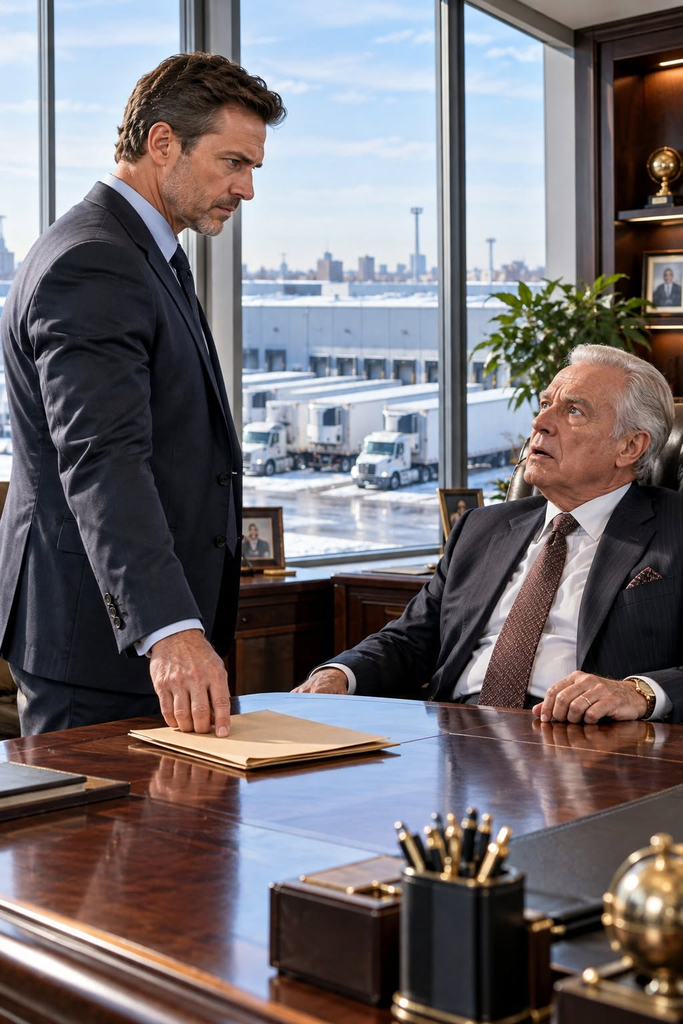
The hum of the refrigerated trucks outside Walter’s corner office sounded distant and muted against the suffocating silence in the room. Walter stared down at the yellowed parchment resting between his liver-spotted hands, his breathing shallow and uneven. For twelve years, I had known him as an untouchable titan of Midwest freight, a man whose word was absolute law from the loading bays to the corporate boardroom. Now, stripped of his bravado, he looked like a fragile old man trapped in a corner of his own making.
“In the summer of 1994, this company wasn’t Langston Cold Logistics,” Walter began, his voice barely rising above a whisper. “It was Vance & Langston. Eleanor provided the initial capital and the hospital network, while Evelyn and I managed dispatch and the fleet. We were equal partners, with Evelyn holding the deciding fifteen percent stake in trust for our daughter, Clara.”
Walter swallowed hard, his eyes refusing to meet mine. “When Evelyn was diagnosed with cancer, our margins were razor-thin. Eleanor wanted to sell a portion of our routes to keep us solvent, but I refused. After Evelyn passed, I panicked. I took advantage of Eleanor’s grief and my position as executor of Evelyn’s estate. I altered the operating agreement, manufactured an emergency capital call that Eleanor couldn’t meet on forty-eight hours’ notice, and stripped her of her thirty-five percent equity. I pushed her out into the cold and renamed the corporation overnight.”
The pieces fell into place with brutal clarity. The mysterious hostility between the two transport giants, Walter’s sudden paranoia whenever Apex secured a regional contract, and the abrupt fifty percent cut to my compensation.
“You didn’t cut my pay to save operational costs,” I said, cold realization setting in. “You cut it because you found out Eleanor was circling back.”
Walter slumped in his leather executive chair, nodding slowly. “Three months ago, Eleanor’s forensic auditors subpoenaed the 1994 probate archives. She discovered that Evelyn’s original fifteen percent trust shares were never legally dissolved—they were merely hidden behind shell entities I controlled. By law, those shares belong to Clara upon turning thirty. When Clara turned thirty sixteen years ago, I never transferred them. I cut your salary because I was liquidating cash reserves to pay off hush-money retainers for corporate defense attorneys. I thought if I tightened your leash, you and Clara would remain dependent on Langston, keeping her from asking questions about her mother’s inheritance.”
I picked up the manila folder containing my resignation and tapped it against the desk. “You treated your own daughter like a liability to protect a thirty-year-old theft.”
“Nicholas, please,” Walter begged, his voice cracking with desperation. “If Eleanor and Clara join forces, they control fifty percent of the voting stock. They can force a forensic audit, remove me as chief executive, and dissolve the company entirely. Everything I spent three decades building will be dismantled in an afternoon!”
“You didn’t build it alone, Walter,” I replied evenly. “You stole it from your partner, hid it from your daughter, and exploited my loyalty to keep your trucks moving while paying me half of what I was worth.”
Without another word, I turned and walked out of the executive suite, leaving Walter alone with his past.
When I arrived home that afternoon, Clara was sitting at the kitchen table with Eleanor Vance. Resting between two cups of black coffee were the original incorporation binders, Evelyn’s probate records, and a formal shareholder proxy agreement. Clara’s eyes were rimmed with red, but her posture was resolute.
“He told you about 1994, didn’t he?” Clara asked quietly as I walked in.
“He told me everything,” I said, setting my briefcase down and pulling out a chair beside her.
Eleanor adjusted her glasses, looking at me with the steady, calculating gaze that had made her a legend in logistics. “Your husband never broke his confidentiality agreement, Clara. Walter’s own arrogance brought him down. The moment he tried to starve Nicholas out of the company to fund his legal defense, he guaranteed his own collapse.”
Over the next two hours, the strategy became clear. Clara wasn’t interested in destroying the business her mother had helped create, nor did she want the sixty-eight drivers and dock workers to lose their livelihoods in a bitter courtroom battle. Instead, Clara executed her rightful shareholder claim, transferring voting control of Evelyn’s fifteen percent stake directly to Eleanor Vance’s consortium.
Combined with Eleanor’s newly validated thirty-five percent original interest, they held an indisputable fifty percent majority of the voting rights.
The following Monday, an extraordinary meeting of the board of directors convened at Langston Cold Logistics. Flanked by corporate attorneys, Clara and Eleanor walked into the executive boardroom. Walter sat at the head of the mahogany table, looking defeated and broken before a single word was spoken.
Rather than facing public criminal indictments and humiliating fraud trials, Walter was given an ultimatum: step down immediately as Chief Executive Officer, surrender his voting stock into a non-voting dividend trust, and retire with full medical benefits to his winter home in Florida.
With trembling hands, Walter signed the transition documents, surrendering the empire he had stolen three decades prior.
Thirty days later, a joint press release sent shockwaves through the Midwest transport sector. Apex Thermal Logistics and Langston Cold Logistics announced a comprehensive operational merger under a newly formed corporate umbrella: Vance & Bennett Cold Transport.
I took the helm as President and Chief Operating Officer, overseeing a unified fleet of over one hundred and forty refrigerated trucks spanning five states. Frank Kowalski was promoted to terminal operations director, and every dock worker and driver received guaranteed pay increases and enhanced retirement matching.
On my first official morning as COO, I walked through the cavernous dispatch bay of the central Chicago terminal. The tracking screens glowed bright green, tracing hundreds of temperature-sensitive hospital deliveries crossing the frost-covered highways without a single delay.
Clara stood waiting for me beside bay four, holding two mugs of hot coffee. We looked out at the rows of modern trailers bearing the newly painted crest of the company her mother had dreamed of building. For the first time in thirty years, the books were clean, the debt was paid, and the family was finally whole.