“I didn’t live here yet,” I said. “We moved in fourteen months ago. That report is dated almost two years back.”
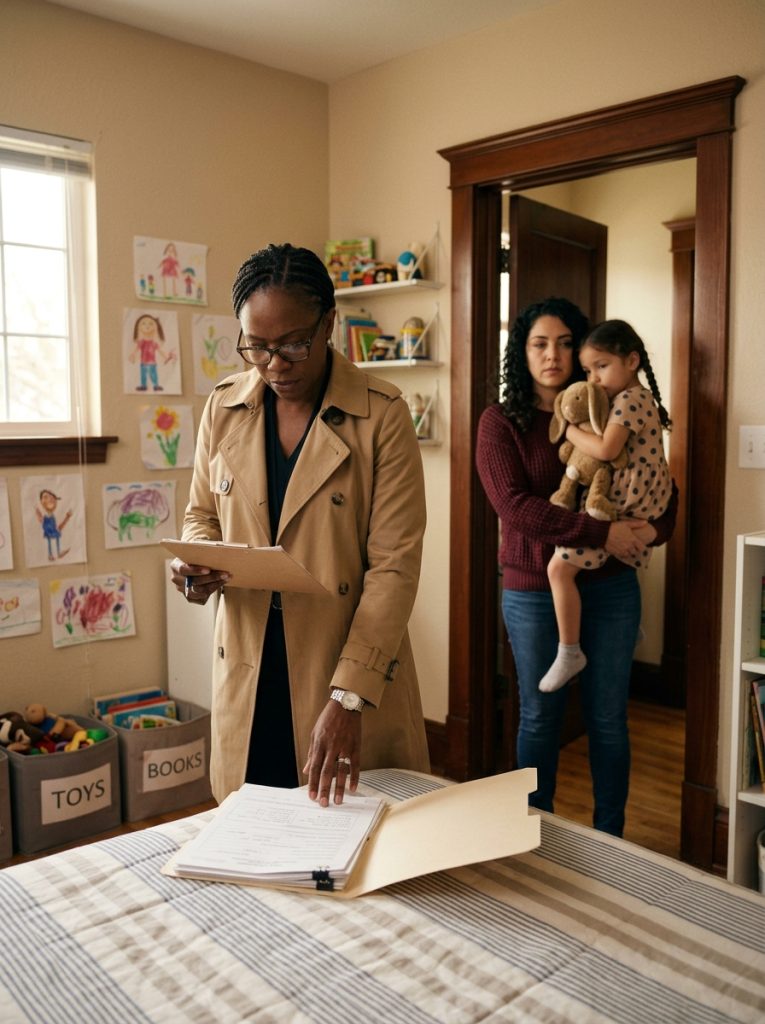
Diane Okafor didn’t answer right away. She set her clipboard down on Mia’s neatly made bed and started laying the pages out side by side, the way you’d lay out cards you suddenly don’t trust.
“This photograph,” she said slowly, “is labeled as your kitchen. Dated last spring.” She held it up. Grimy counters. A sink full of dishes. A water-stained ceiling. “Is this your kitchen?”
“I don’t have a water stain on any ceiling,” I said. “And those aren’t my cabinets. Mine are white. Come look.”
She came and looked. White cabinets. Clean sink. No stain.
She went back to the file and got very quiet, and I watched a by-the-book woman start to realize the book she’d been handed was forged.
“There’s a medical report here,” she said. “It states your daughter missed four pediatric appointments and presented with an untreated injury. Signed by a Dr. Whitman.”
“Mia’s pediatrician is Dr. Osei,” I said. “She’s never seen anyone named Whitman. Call the office. Please. Call them right now.”
She called.
I sat on the floor with Mia and her stuffed rabbit while a caseworker who’d arrived expecting to take my daughter stood in my hallway and made phone calls that slowly turned the case inside out.
There was no Dr. Whitman at the clinic. There never had been. Mia’s actual records, which the office read out over the phone, showed every appointment kept, every vaccine on schedule, no injuries, a healthy five-year-old.
The “filthy kitchen” photo, it turned out later, was pulled from an online rental listing for an apartment three towns over.
The dates didn’t just not match. They couldn’t match. Several of the “documented incidents” were placed at an address where I hadn’t lived yet, on days I could prove I was at work, with timecards and a manager who remembered.
The whole file was a fiction. A well-formatted, professionally laid-out fiction.
And there was only one person with a motive to build it.
“Who filed the original complaint?” Diane asked, flipping to the front page.
We both already knew. My ex, Brandon. He’d told me, the last time we fought, that he had a lawyer who could “make me look like exactly what the court expects a single mom to be.” I thought it was a threat made of air.
It was a threat made of paper.
Here is the thing nobody tells you. When someone fabricates evidence against a mother, the system is built to believe the paper first and the mother last. A tidy home and a clean record don’t shout as loud as a stamped report. If Diane Okafor had been a little less rigid — if she’d skimmed the file and trusted it instead of checking every line against the room in front of her — I would have lost Mia that afternoon.
Her by-the-book nature, the thing I’d feared on her drive over, was the thing that saved us. Because the book, read all the way to the bottom, didn’t add up.
“Ms. Moreno,” she said, closing the folder. “I came here today prepared to remove your daughter. I want to be honest about that.” She took off her reading glasses. “Instead I’m going to write the truest report I’ve ever filed. And I’m going to flag this file for fraud.”
She did more than flag it.
She testified.
The custody hearing that was supposed to strip me of my daughter turned into something else entirely. Brandon’s lawyer tried to lean on the documents until Diane took the stand and walked the court through every forged date, every invented doctor, every photo lifted from a rental site. She’d done the work. She had the rental listing printed out. She had my timecards. She had Mia’s real medical file.
The judge’s face changed by the second.
When it was over, I didn’t just keep custody. The court flipped it. Brandon’s visitation was cut to supervised. The judge referred the fabricated filings to the district attorney, and the lawyer who’d built the file found his own name in a bar complaint. Forging evidence in a custody case isn’t a clever strategy. It’s a crime, and it’s the kind judges take personally.
Brandon called me afterward, furious, demanding to know how I’d “turned the caseworker against him.”
“I didn’t,” I told him. “You handed her a lie and she could read.”
Then I hung up, because Mia was tugging my sleeve, and a five-year-old’s needs outrank a coward’s tantrum every time.
Diane Okafor stopped by once more, weeks later, to close the file in person.
She knelt down to Mia’s level and admired the stuffed rabbit, then she stood and shook my hand.
“For what it’s worth,” she said, “your home is one of the cleanest I’ve ever inspected. I’m sorry it took a forged folder to put that in the record.”
“You read it all the way to the end,” I said. “Most people would’ve stopped at the first stamp.”
“The first stamp isn’t the truth,” she said. “It’s just the loudest part.”
She left. I closed the door. Mia was already setting up a tea party for two on the floor of the bedroom they’d tried to take her from.
I sat down across from her, accepted a cup of invisible tea, and let my hands finally stop shaking.
They called me an unfit mother on paper.
But paper can’t tuck a child in. And in the end, the only lie in my whole life was the one they typed and sig